In New York, the year that is drawing to a close was marked by a true return to the pleasure of live performance. Going to the theater felt almost normal again. Sure, theaters were a bit emptier than before the pandemic, and that is understandable. Some people are still nervous about spending hours in close proximity to others, especially now that the masks are coming off. But many are returning, reacquainting themselves with the irreplaceable sensation of sharing time and space with extraordinary performers, knowing that what one is about to see will never again be repeated in quite the same way.
Link copied to clipboard
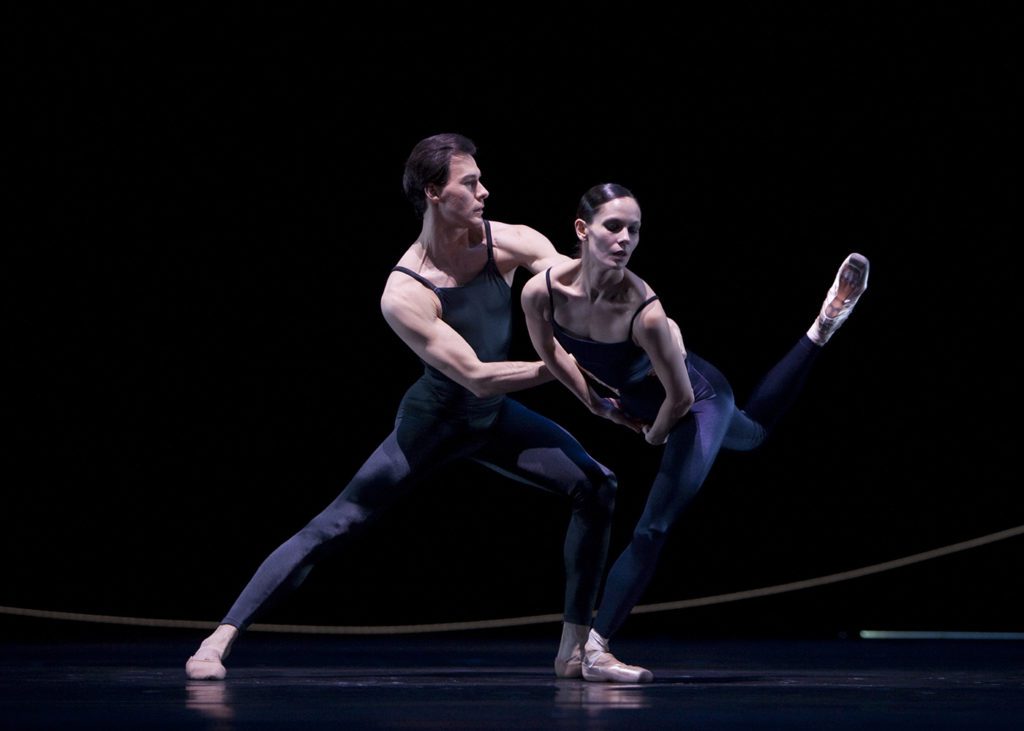
Peter Walker and Mira Nadon in Justin Peck’s “Bright.” Photograph by Erin Baiano
There were good nights and bad ones and everything in between. Here, in no particular order, are some of the dance performances that stayed with me:
Bijayini Satpathy in rehearsal for her solo Odissi performance. Drive east 2019
The Odissi dancer Bijayini Satpathy, formerly a member of the Nrityagram Dance Ensemble, spent the long months of isolation during the pandemic expanding her dance vocabulary in her rooftop studio near Bangalore. She is a singularly powerful performer, with an intense focus that immediately captures your full attention. When you watch her, you can think of nothing else. Her new evening-length “Dohā,” inspired by a couplet composed by the 18th century Urdu poet Mir Taqi Mir, was like a voyage through her imagination, mercurial, internal. (“Dohā” was performed in the theater at the Metropolitan Museum in September.) But much as I was struck by it, I loved a short solo she performed in one of the museum’s galleries, the Astor Chinese Court, even more. There, dancing on a reconstructed balcony, to a score for guitar by Bindhumalini Narayanaswamy, Satpathy enacted a scene in which a woman moves through an enclosed garden, creating her own diversions and pleasures out of thin air. There, she read a book, picked an invisible flower, and gazed out of a partially-obscured window, as if awaiting a lover. And she danced for herself.
Surupa Sen, Satpathy’s former dance partner, brought the Nrityagram Dance Ensemble to New York for the first time since 2018. They performed at Fall for Dance, in a work (“Poornāratī”) by Sen that incorporated dancers from the Sri Lankan company Chitrasena. The choreography and dancing, which highlighted contrasts between the speed and athleticism of the Kandyan dancers and the sway and rounded movements of the Odissi dancers, was thrilling. The dancers seemed to be engaged in a conversation, riffing off of each other’s phrases, multiplying each other’s utterances with counterpoint, canon, call and response. Sen, a wonderful dancer, sat on the sidelines, singing in her alto voice as part of the musical ensemble. The energy was electric.
Dutch National Ballet in “Variations for Two Couples” by Hans Van Manen. Photograph by Angela Sterling
On that same program, four dancers (Maia Makhateli, Olga Smirnova, Constantine Allen, and Jakob Feyferlik) from Dutch National Ballet performed “Variations for Two Couples,” by Hans Van Manen. The extraordinary thing here was not Van Manen’s smooth, fluid choreography, all lithe movements unspooling to Benjamin Britten and Piazzolla in the penumbra. It was the dancers. All four were impossibly beautiful, exemplars of a certain idea of what ballet dancers should look like, with exquisite proportions complemented by physical and facial gorgeousness, impossibly long lines, and a kind of otherworldly, inhuman elegance of movement. I’m not saying that all dancers should look like this, far from it. I wholeheartedly embrace a variety of physiques and looks and personalities onstage. But these four dancers were undeniably poetic—and they made ballet technique look exquisitely cool, restrained, and super-heroic. The most impressive of all was Olga Smirnova, formerly of the Bolshoi, a dancer who is not only a paragon of her craft, but who has also proven herself to be brave and principled, leaving Russia after Putin launched his bloody and senseless war against Russia’s neighbor, Ukraine. The awareness of her inner strength added even more power to her performance.
Mira Nadon and Aaron Sanz in “Piano Pieces” by Jerome Robbins. Photograph by Erin Baiano
Two dancers at New York City Ballet, Mira Nadon and Alexa Maxwell, stood out to me in particular this year. Nadon, in everything she danced (except perhaps for the Lehar waltz in “Vienna Waltzes,” in which she was miscast). Maxwell, who is still in the corps, made her mark in all her corps roles, which she dances with a sense of delight and fulness that consistently light up her corner of the stage. But also, in her début in Jerome Robbins’s “The Cage,” which she danced with a fury and abandon that surprised, I think, everyone. Clearly, this dancer has a lot more in her than corps parts can show. Nadon, a soloist, made a particularly strong impression in Robbins’ “Piano Pieces,” revived this year. She and Aaron Sanz danced to Tchaikovsky’s “Chant d’Automne,” a melody full of yearning and sadness. Her dancing was both yielding and free, with a natural ebb and flow that seemed to spring, not from her arms and legs but from something deep within her—a musical impulse that found physical expression in each step, stretch, and pause.
Sterling Hyltin in
“Afternoon of a Faun” by Jerome Robbins.
Photograph by Paul Kolnik
And Sterling Hyltin, also of City Ballet, had one of the most satisfying, well-rounded, and elegantly-danced final seasons I have seen. In ballet after ballet, from “The Cage” to “Concerto DSCH” to “Symphony in Three Movements,” this spirited, generous dancer seemed to find an extra something, sharing her pleasure in being onstage, and in dancing with her colleagues, with the audience. In her farewell, as Sugarplum in “The Nutcracker,” she once again deployed the singular lightness, wit, and warmth that have characterized her dancing for almost twenty years.
Cory Stearns (Prince Coffee), Devon Teuscher (Princess Tea Flower), Daniil Simkin (The Boy), and Breanne Granlund (Princess Praline) in “Whipped Cream” by Alexei Ratmansky. Photograph by Kyle Froman
What a relief to see American Ballet Theatre back at the Metropolitan Opera for the first time in three years. Ratmansky’s “Whipped Cream” was a delight, a paean to ballet’s capacity for whimsy and joy. But my favorite program may have been the one that combined Frederick Ashton’s “The Dream” and Ratmansky’s “The Seasons,” two ballets that revel in the detail and richness of the classical vocabulary, while extending it in different ways. Gillian Murphy glowed as Titania, a petulant and sensual queen of the fairies in Ashton’s ballet. Daniel Camargo, her partner, is a dancer with a rare ability to subtly transform his characters from within, through acting that expresses itself in each movement. And “The Seasons,” made for the company in 2019, is a gift to the whole company, with role after role fashioned with the specific aim of highlighting the dancers’ abilities, personalities, and relationship to each other.
Twyla Tharp's “In the Upper Room” at City Center. Photograph by Christopher Duggan
I thought I had tired of Twyla Tharp’s footloose, jazzy Americana. The last few revivals of “In the Upper Room” at ABT have fallen flat, and the new works I’ve seen in recent years have left me feeling empty. But the double-bill Tharp presented at City Center this fall, composed of “In the Upper Room” and “Nine Sinatra Songs,” brought it all back: The thrill of her driving, highly physical style of dancing, the intensity it brings out in the dancers, the deadpan humor, the sweat. This new ensemble, which included Cassandra Trenary of ABT, Lloyd Knight of Martha Graham, and Jeanette Delgado, formerly of Miami City Ballet, brought a sense of joy, effort, and discovery to the dances, and made them live again. I now realize that “Upper Room” should be seen at City Center, not on the much larger and more remote-feeling stage of the Met.
In many ways it has been a terrible year on the global stage. On February 24th, out of the blue and with the flimsiest of invented excuses, Russia invaded Ukraine, where until that moment people had been living their lives in peace and normalcy. For Ukrainians, normalcy ended that day. Cities have been flattened, innocent people killed, infrastructure destroyed. Ukraine’s many theaters have been forced to cease activities, or reduce them to a shadow of what they were before the war. An estimated 20% of the country’s population has had to leave, including of course many artists. (Many more are internally displaced.)
In August I was able to spend some time with an ensemble of exiled Ukrainian dancers that has come together in the Netherlands, thanks to the initiative of the dancer Igone de Jongh. They have come from all over Ukraine (Kharkiv, Odessa, Kyiv, Donetsk), and though safe, they are separated from their families and former lives. At the time I was there they were (are still?) living, taking class, and rehearsing in a former conservatory in The Hague. Everyone was tired and stressed, but also united by this common project, which everyone involved saw as an expression of love and pride in being Ukrainian. The startup company is called the United Ukrainian Ballet.
With great effort, they put together a staging of “Giselle,” led by Alexei Ratmansky, who spent the first ten years of his life in Kyiv (and started his dancing career there) and is of Ukrainian and Russian descent. He was assisted by his Ukrainian wife, Tatiana, also a former dancer. The production, which I saw in Alphen aan den Rijn (and which later toured to Amsterdam and London), was a testament to the talent, grit, and spirit of these dancers, working and living under truly trying circumstances. I remember one dancer in particular, Vladyslava Ihnatenko, just 19, who had been in her first year at the Odessa Opera House when the invasion began. When she heard explosions, she grabbed a bag of dance clothes, ran to the home of a family friend, and then set off for the border.
Another dancer I saw in The Hague, Stanislav Olshankyi, a principal at the National Ballet of Ukraine,recently joined Miami City Ballet, where he justperformed his first Balanchine “Nutcracker." A “Ukraine abroad” is forming, all over the world. May they have the chance to return home soon.
Marina Harss
Marina Harss is a dance writer in New York, a frequent contributor to the New York Times and the New Yorker Magazine, as well as to Dance Magazine and Fjord Review. She is the author of a book about the choreographer Alexei Ratmansky, scheduled for publication by Farrar Straus and Giroux in 2023.
subscribe to the latest in dance
“Uncommonly intelligent, substantial coverage.”
Your weekly source for world-class dance reviews, interviews, articles, and more.
The lights dim and the mystical Eye of Horus commands our focus. Hieroglyphics and distinctive carvings flank the famous Egyptian symbol of resurrection as the overture swells and the drop curtain morphs into a portal to the past.
Fresh from performing the concert version of George Balanchine’s “Who Cares?” at the Hollywood Bowl earlier this month, Los Angeles Ballet mounted a tribute to “American Icons” which included Jerome Robbins “The Cage,” Paul Taylor’s “Dilly Dilly,” and the return of artistic director Melissa Barak’s “Wavelength” for an evening at the Broad Stage in Santa Monica.
Born in 1969 to a pair of gifted dancers—Marilyn Jones and Garth Welch—in Melbourne, Australia, it only seemed natural that their son, Stanton Welch, would follow in his parents’ balletic footsteps.
Malandain Ballet Biarritz is approaching the end of an era. After nearly three decades at its helm, Thierry Malandain will hand over the direction of the Centre Chorégraphique National to Martin Harriague in January 2027.








comments