In an extended phone interview, I had the pleasure of posing question after question to Boris Charmatz. He told me about his various projects as dancer and choreographer, starting with association EDNA, the Musée de la Danse and finishing with his artistic direction, as of September 2022, of the world-renowned Tanztheater Wuppertal Pina Bausch. This interview has been edited for length and clarity.
Link copied to clipboard
“10000 Gestures” for Musée de la Danse, choreographed by Boris Charmatz. Photograph courtesy of the artists
In 1992 you created the Association EDNA with Dimitri Chamblas. What does this association do and how did it come about?
I don’t know if it was a weakness or a strength, but back then I didn’t want to choose between being a choreographer and a dancer. I wanted to study further, be a viewer, take workshops with various choreographers, and so on. When I was seventeen, after the Paris Opera School and Conservatory of Lyon, I started my professional career as dancer. Simultaneously I also studied history of art by correspondence. In the same period I started association EDNA with a duet with Dimitri Chamblas, which we are still performing 30 years later! This year we will present it at Montpellier Danse. EDNA was born for our work, but also to make laboratories for collaborating with visual artists, song poets, thinkers, and so on. It was based on very experimental residencies in the Alps and outdoors, and thanks to those I have worked with Steve Paxton, Xavier Le Roy, Jennifer Lacey, and many other artists. I have always liked the idea of being permeable, open to other choreographers’ and dancers’ ideas, and collaborating with other choreographers and artists.
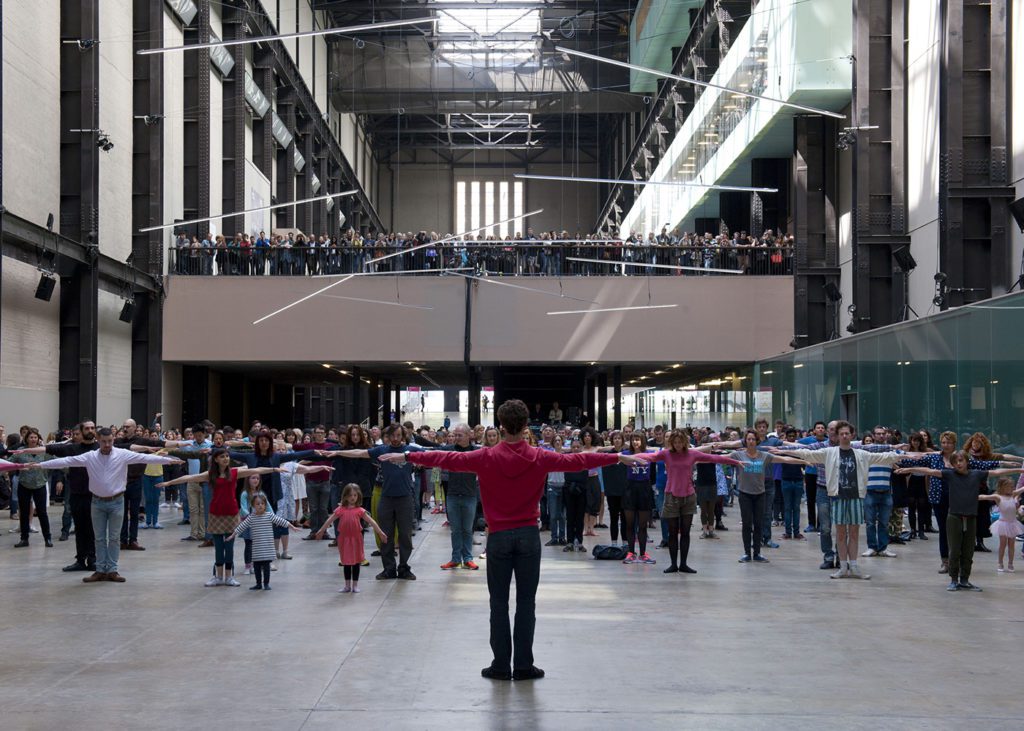
Musée de la Danse: Public warm-up with Boris Charmatz at the Tate Modern, London. Image courtesy of the artists
In 2012 you started Musée de la Danse, which was born, quoting you, “from an anti-natural crossbreeding between museum, place of preservation, dance, art of motion, and choreographic centre, a place of production and residence.”
Musée de la Danse lasted ten years, based in Rennes, where we did lots of different exhibitions. We also did contact improvisation and a lot of live exhibitions that are still touring now. For example, “Twenty Dancers for the XX Century” is still touring. It’s a live exhibition with 20 artists working on their own dance archive and presenting their solos from the 20th or 21st centuries. Now the Musée de la Danse is closed, and in the same place there is a choreographic centre taken care of by a hip-hop group, so something different. The very important thing when we began was imagining the various possibilities of such a space, which was both a mental and physical space. Some people thought it was a joke, others took it as deadly project, thinking that dance would die in a museum. Now it seems very possible to have a dance museum, but back then it was difficult to imagine. I still think we should have more dance museums in the world.
In 2009, years before the opening, we were already very busy with the ideas of how to display dance. What kind of museology could we build, what is our relation to history and memory? Why and how to showcase dance in a museum? What kind of space do we need for it? Is the museum in videos? in the head? What does the viewer expect and experience in the Musée de la Danse? He/she will think that s/he will visit dance, but maybe dance will visit him/her. It was an incredibly creative moment for me. I could work with many dancers, artists, visual artists, archivists, curators, architects, etc. It was an amazing phase that led us to so many different spaces, such as the Soviet Memorial in Berlin, the Tate Modern, MoMA. In particular at MoMA and at the Tate we could develop the project at an extraordinary scale, and we still carry those experiences with us.
In the beginning we were not at all thinking to connect with art museums, we were only thinking to create our own museum. We were a small and poor institution, but we gained a certain appeal and power reconstructing movements of Charlie Chaplin, Martha Graham, Isadora Duncan, Mary Wigman, Cunningham, Forsythe, De Keersmaeker, Simone Forti, and many others, including forgotten choreographers and dancers. MoMA saw us as an important contribution to its museum collection.
Museums have missed a little the performance idioms of the sixties, so they were trying to collect the photos, the videos, the scores of those performances, and there was—and still is—a strong desire from museums to be seen as living places. We are still asked to bring dance into museums, and we still do it sometimes because it’s important for all the parties involved and because it brings joy and enthusiasm to all the participants.
Public warm up for “Fous de danse,“ a project by Musée de la Danse, directed by Boris Charmatz in collaboration with Sandra Neuveut. Photograph by MuTphoto/ Barbara Braun
Moving on to [terrain], you wrote, “I want to create a choreographic green space. A dance terrain. A human architecture project, where moving bodies form the visible mobile architecture of a new institution.” How did you realize your vision?
When we were doing Musée de la Danse in Rennes we didn’t have the right spaces. We had small dance studios. So we wanted to be in connection with the open spaces and the public. Rennes is really rainy, but we decided to take the risk to go outdoors. It was 2015, when we experienced the terrorist attacks, and the public was full of anxiety. I realized it was important to bring dance into those empty squares and parks. For example, “Fous de Danse,” with Syrian dancers in Berlin in September 2007, when the Alternative für Deutschland (extreme right party) was rising, or Rennes after the attacks at Charlie Hebdo. There was and there is still a desire to assemble so I asked myself what kind of choreography could we do in this intense moment and how could we rethink those public spaces. I imagined a dance theatre in a green public space, an institution but with no walls and no ceilings, so the opposite of a stable building. The challenge was how to build a place with only our bodies and the energy we spent there. [Terrain] is still going on. Of course, in Wuppertal it is different, because the work of the ensemble is presented with grandiose sets, normally in the theatre. We’ll do some [terrain] in Wuppertal as well, but with in-situ projects. [Terrain] is a bit like Musée de la Danse; it is an idea, a very active idea that helps us in creating specific projects.
You often work with amateur dancers. Can you tell me what the challenges are in creating choreographies with very large numbers of non-professional dancers?
Dance is an amazing galaxy. It’s a universe. It happens in the shower, in a club, in bed, in a dance studio. It happens onstage with super-skilled dancers, but it happens for kids and elderly people as well. It is not only for the 20-to-35-year-old energetic dancers. It really is for everyone. The first project I will do, in May, is called “Wundertal,” and I want the ensemble of the 30+ amazing professional dancers to meet with students, amateurs, youngsters, elderly people, visual-arts people, theatre people, professional actors—a street happening. It’s a complex, mad project, but it is a real piece. The idea is to push people to perform outside, whether it’s raining or not. I like the drug-energy that dance can give, and it is not in opposition to doing pieces of Pina’s repertoire or the pieces I will choreograph from next year that will tour. For years people have gone to see pieces by Pina at the Wuppertal Operahaus, but she did projects with different people herself, for example, “Kontakthof,” with the elderly and with teenagers. The company had children’s programs as well. She did a full film shot outside, called “Der Klage der Kaiserin” (The Lament of the Empress).
What’s your role at Tanztheater Wuppertal Pina Bausch (TWPB)?
I am in Wuppertal as artistic director, to develop Tanztheater and that’s the main thing. Important to say, though, that this current season was already pre-planned for the Tanztheater and for [terrain], so we have a transitional year. I will plan the program from next year’s season. I see this as a learning year. The Tanztheater Wuppertal is a global company, but I want it to work very much in the neighbourhood countries and, in particular, in France, not only for the climate, as we don’t want to take so many planes, but also because the neighbourhood goes with a line of coal. There is a geological crack going from Manchester to north of France, where I am working, to Belgium to Wuppertal. I have the impression that the landscape, the economy, and ecology are different but they all have a common history of social crisis, coal crisis, textile crisis, steel crisis, and at the same time the capacity to reinvent themselves via their culture. So I feel that [terrain] is a good tool for Wuppertal because I want to foster a very strong French-German connection. [terrain] is [meant] to present strange things. It is exactly what Tanztheater Wuppertal is not. In [terrain] there are four to five producers doing in-situ and outside works and improvisations, and in Wuppertal there are the specialists of Pina Bausch work, so it makes sense to combine the two, to collaborate. We’ll see how far we can go.
“10000 Gestures” for Musée de la Danse, choreographed by Boris Charmatz. Photograph courtesy of the artists
How do you see your own practice inside this special position?
Firstly, I am learning a lot and I am sure I will continue to learn over the next years as well. I want to work collectively, not alone. Now that I am the artistic director of Tanztheater Wuppertal Pina Bausch, I have an amazing team of 70 people. Then there is the Pina Bausch Foundation, the future Pina Bausch Zentrum (centre), and all the interest of former dancers, many of them still living in Wuppertal, the students interested in Pina’s work, the critics, etc. It’s amazing, the galaxy around Pina Bausch. So I am there to join the team and collaborate.
The basic structure that I have in mind is that the Pina Bausch repertoire will go on as it has been going on for more than 30 years and as it is going on in many other ensembles, such as the Paris Opera Ballet, the African version of “The Rite of Spring” by Common Ground, the Flanders Ballet, etc. Of course, the DNA of company will go on, but let’s say it will be seen with new glasses. There are lots of questions about climate, gender, and the perception of various realities, so how can we adapt those pieces for now, even though they are 35 years old? There is continuation, and there are ways to experiment or curate around those works. Because I am coming from the Musée de la Danse and because we are just starting “Café Müller” with a new cast, I was thinking that “Café Müller” is endless. It has been performed for 35 years, but also there is a revolving door. A café closes and opens over and over again, so I was thinking, how could we have a permanent “Café Müller”? For example, an 8-hour “Café Müller” or an exhibition with a 48-hour “Café Müller,” and see how we relate with the audience then? How can we reframe the old creations, taking some risks? Then we’ll see how it goes and if it works or not.
You have “Singing in the Rain” that is so famous; we are going to be a “Dancing in the Rain” company [laughs]. We’ll go out of a certain comfort zone, because Pina Bausch was and is radical. Going back to “Café Müller,” there are two sets, one with the walls of glass, another with the original set, and I have just found a picture where the audience is outside and the performers inside the building, so something completely different. So we think the piece is a fixed thing and the company is a permanent thing, but actually it was never fully fixed. She would always rework it, rethink it, changing the costumes, the lights, the stage etc. The tendency is to not touch something because she is not there anymore, but actually it has been already touched. The dancers have been changing, the world is changing, the perception of racism is changing. It is not me bringing the conversations into the company, it’s already happening.
So, in sum, your vision for such a stratified, history-crammed, and world-renowned ensemble?
Firstly, to do new pieces because the company can’t only be a repertoire company. Secondly, to connect Pina Bausch work to artists such as Susanne Linke, Heinrich Hoffmann, Helmuth Holger, and many others that worked at the same time as Pina, such as Wim Vandekeybus and Rainer Werner Fassbinder. The third thing is to find a new ground for the company, for now and for the future. In the last 13 years they had new creations with Dimitris Papaioannou, Alan Lucien Øyen, Tino Sehgal, and others, so the question in this moment is: what can we do now that I am here?
“Fous de danse,” a Musée de la Danse project directed by Boris Charmatz. Image courtesy of the artists
Do your innovative ideas for the company find any resistance in Wuppertal?
Resistance is not a problem, and resistance was there before I arrived. It has been a chaotic artistic directorship, as in the last twelve years there were four different directors, so I don’t think I am bringing any kind of resistance. I actually feel very welcomed by the city, the politicians, the dancers, and the team. I want to mention Peter Pabst, set designer for most of Pina’s works. He is a sort of mountain, an icon. Why would he welcome me? Most of the time I perform without set. But still we have very interesting and constructive discussions. So, yes, I feel very welcomed, but it doesn’t mean that it goes without any resistance. My desire is to work with everyone. I am not choosing the dancers that are interesting to me, I want to work with all of them, but then the company changes because some people retire, some people dislike my work, and that’s okay. It’s an adventure! After all, the work of Pina was sometimes well received and sometimes not at all. Some people are fans of the ’70s to ’80s; others are fans of the 21st century. Everyone has his/her own tastes. Anyhow, it’s a very daring choice to not turn the company into a museum with the repertoire of Pina but to try to find a specific identity with my presence. To choose a choreographer was a clear choice from Salomon Bausch, the city, and the dancers. I admire that they opted for this choice. I proposed other solutions, but they wanted an artist. So, okay!
Can you tell me more about “Wundertal” and your next work with the company?
“Wundertal” is a series of events with 200 people. It starts on the 21st of May in one street of Wuppertal. This will be a happening-party, and then there is “Palermo Palermo” as part of “Wundertal.” In the following days there will be other events. As for my work as choreographer with the company, it will be in September, but more on that in a few months.
I read that you are considered a choreographer and artist who does “impossible projects.” Any other “impossible projects” you would like to reveal if only as a dream?
I think the most impossible project was to accept the Wuppertal [assignment]! [laughs] It’s really a challenge, not only for a month or a year but for years to come, and it will surely be a rollercoaster. We always want to stay up, but we need to go down to go up again. I am a mountain guy, so I like to go up and down. [laughs]
Veronica Posth
Veronica Posth is an art historian and art and dance critic based in Berlin. She studied Art at the University and Fine Art Academy of Florence, at the University of Glasgow and at the University of Applied Sciences in Potsdam; and Dance in various schools and academies in Florence, London, Glasgow and Berlin. Besides reviewing art and dance for numerous printed and online magazines, Veronica also works as a dance dramaturge.
subscribe to the latest in dance
“Uncommonly intelligent, substantial coverage.”
Your weekly source for world-class dance reviews, interviews, articles, and more.
The lights dim and the mystical Eye of Horus commands our focus. Hieroglyphics and distinctive carvings flank the famous Egyptian symbol of resurrection as the overture swells and the drop curtain morphs into a portal to the past.
Fresh from performing the concert version of George Balanchine’s “Who Cares?” at the Hollywood Bowl earlier this month, Los Angeles Ballet mounted a tribute to “American Icons” which included Jerome Robbins “The Cage,” Paul Taylor’s “Dilly Dilly,” and the return of artistic director Melissa Barak’s “Wavelength” for an evening at the Broad Stage in Santa Monica.
Born in 1969 to a pair of gifted dancers—Marilyn Jones and Garth Welch—in Melbourne, Australia, it only seemed natural that their son, Stanton Welch, would follow in his parents’ balletic footsteps.
Malandain Ballet Biarritz is approaching the end of an era. After nearly three decades at its helm, Thierry Malandain will hand over the direction of the Centre Chorégraphique National to Martin Harriague in January 2027.







comments