Despite what the world is suffering this year, two of Europe’s most prestigious international summer dance festivals commit to go forward with drastically truncated, yet vital and imaginative programs. Berlin’s Tanz im August, under the artistic direction of Virve Sutinen, and the Venice Biennale’s Festival Danza under Marie Chouinard’s curatorial leadership will open in late August and mid-October respectively. Each artistic director spoke with me via Skype and Zoom recently about the hardships and angst of redesigning their festivals during this brutal pandemic. This month, we feature Tanz im August and how they pivoted from cancellation to a ten-day online festival with some physically distanced public performances, all free, and most available on YouTube as well.
Link copied to clipboard
Arkadi Zaides‘ “NECROPOLIS.”
Photograph by Institut des Croisements
Sutinen, in mid-tenure, has two more years to regroup and rethink the usually one-month Berlin festival. Undeterred by present circumstances, she is optimistic about its future. When reached at her Helsinki home, she was her usual upbeat self. Yet evidence of exhaustion and heartbreak about the many losses to the festival kept oozing into the conversation like sap slowly dripping down a tree trunk.
“We began to realize we would have to cancel the festival when Asian companies from countries like Thailand, Indonesia and then Australia and began canceling tours,” she said ruefully. “Without them we couldn’t have an international festival. It’s so stressful, because the travel restrictions are changing every day.”
Tanz im August Artistic Director Virve Sutinen
“There won’t be any show of Boris Charmatz,” Sutinen lamented, “neither on stage nor digital. “He was to have a full retrospective in Paris this fall in public spaces hundreds of people, so he’s in a big mess there.”
“So nothing happened in one day. Before we totally canceled, we took two weeks to speak to every single artist to get their feedback on how go forward. Our economy is very fragile now. It was so emotional. Our artists had done the work and were expecting to be paid; we were able to pay 60% of their fees. And at the same time we offered everyone the opportunity to be on the online program which would require a new contract.”
Although she agreed no one was imagining a pandemic, “I always have a plan A, B and C. Funders were hoping we would still generate something, some artistic contribution. Some of the people were really so happy to have this occupation. Ten of the artists announced their participation, most online, and made proposals. We made new contracts. We usually buy already done work. But this time we went into total production mode, making at least 10 films,” said Sutinen. “We didn’t want them to stream them. Performance is the only capital of artists and to stream it is not a good deal for them. This is their lifeline, and when this (Covid) is over they will start touring their work and not have all that content online. So everything we will present will be produced for this media and public space.”
Working round the clock, with meetings late at night in different times zones, “Were kind of fun,” she said. “William Forsythe volunteered to do a new work for us—an instructional series of short choreographies. There will be maps where you can find these instructions, you go alone or with a partner and look for these signs and do the little dances right there.”
LIGNA creates a polyphonic radio ballet for Tanz im August 2020. Image by Johannes Koether
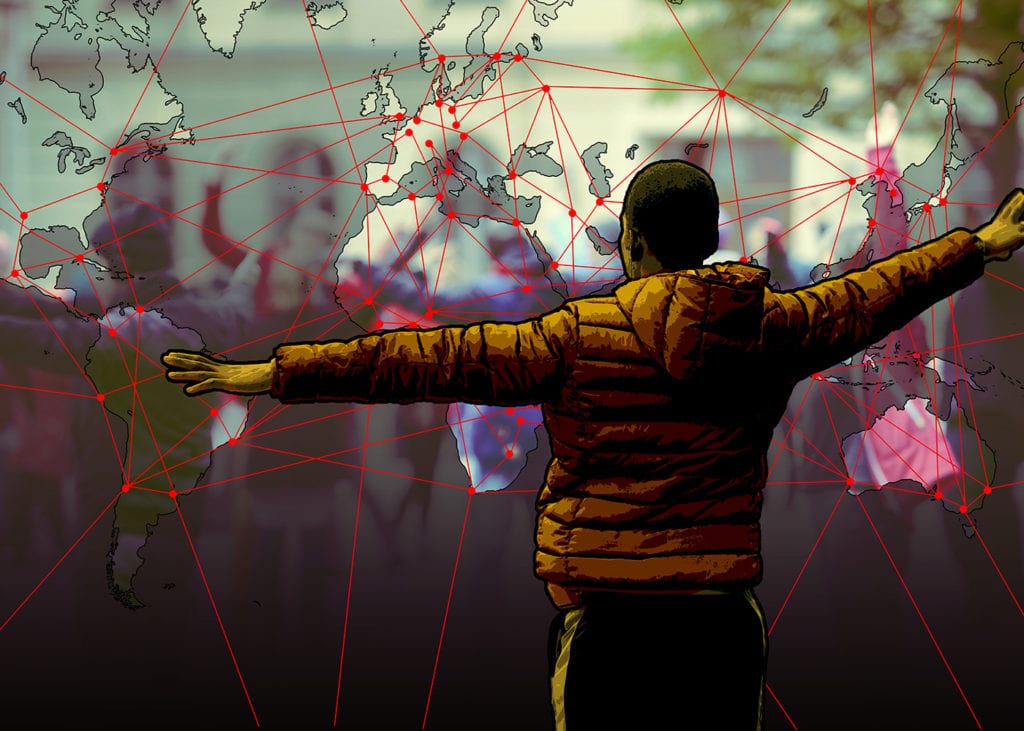
Another outdoor space project is by Hamburg-based LIGNA. They invited 12 choreographers from around the world to their polyphonic radio ballet “Dissemination everywhere!” On four festival days, the participating audience follows this choreographic radio program about the experience of vulnerability and solidarity in public spaces in Berlin via headphones. On August 30, the radio ballet will be shown simultaneously at Tanz im August, the Zürcher Theater Spektakel and the Theater Festival Basel.
Of course with travel restrictions, “Americans like Jaamil Olawale Kosoko won’t be physically here,” she said, “but he’s creating “American Chameleon: The Living Installments (2.0)” an interactive online streamed performance lasting 210 minutes. He’s one of the 10 artists from the original program. He was very well prepared because his premier in Live Arts was canceled. It’s a three-hour event that we are now revising for Berlin and he’ll create a new piece for us.”
Jaamil Olawale Kosoko. Photograph by Sarah Griffith
Black Lives Matter features in a lot of the discussions. “We have prerecorded a talk with Brenda Dixon Gottschild and she already linked his work with the BLM movement.”
Another American artist, Bebe Miller, was invited as one of several choreographers to orchestrate a description of a movement that will be done outdoors. “So when it is done in India, for instance, you can hear the traffic and you feel like you’re traveling around the world.”
My other picks are: “1000 Scores. Piece for Here, Now & Later,” a project by Helgard Haug, David Helbich and Cornelius Puschke, produced by Rimini Apparat, offers an online platform for scores commissioned from various artists. With contributions from the likes of the brilliant conceptualist/performance artist Chiara Bersani, (more on her in the September preview of the Venice Biennale where she will also have a presence) and Maija Hirvanen, Victoria Hunt, Choy Ka Fai, Kettly Noël, this would also be my favored pick.
Faye Driscoll, known for creating performance worlds of sensorial complexity in which viewers feel their own culpability as co-creators, began a series of audio works in 2019 titled “Guided Choreographies for the Living and the Dead” performed at the Walker Art Center in Minneapolis this spring. For Tanz im August 2020, she conjures states of longing and seizes desire in a journey that reflects upon power and presence, yearning and absence.
“Of course my staff and I just dove into this not really knowing a lot,” Sutinen said. “But last November we had a retreat to discuss what is our mission. We had time to debate. We have to find new ways to make artist's works more visible. After we’re done [this festival] we need to take holidays and rethink what are the opportunities and what if we are forced to cancel the live festival again.”
Out of all of this,” she ended, “I think something moved. We have a whole paradigm shift, but those don’t happen too often.”
Merilyn Jackson has written on dance for the Philadelphia Inquirer since 1996 and writes on dance, theater, food, travel and Eastern European culture and Latin American fiction for publications including the New York Times, the Warsaw Voice, the Arizona Republic, Phoenix New Times, MIT’s Technology Review, Arizona Highways, Dance, Pointe and Dance Teacher magazines, and Broad Street Review. She also writes for tanz magazin and Ballet Review. She was awarded an NEA Critics Fellowship in 2005 to Duke University and a Pennsylvania Council on the Arts Fellowship for her novel-in-progress, Solitary Host.
subscribe to the latest in dance
“Uncommonly intelligent, substantial coverage.”
Your weekly source for world-class dance reviews, interviews, articles, and more.
The lights dim and the mystical Eye of Horus commands our focus. Hieroglyphics and distinctive carvings flank the famous Egyptian symbol of resurrection as the overture swells and the drop curtain morphs into a portal to the past.
Fresh from performing the concert version of George Balanchine’s “Who Cares?” at the Hollywood Bowl earlier this month, Los Angeles Ballet mounted a tribute to “American Icons” which included Jerome Robbins “The Cage,” Paul Taylor’s “Dilly Dilly,” and the return of artistic director Melissa Barak’s “Wavelength” for an evening at the Broad Stage in Santa Monica.
Born in 1969 to a pair of gifted dancers—Marilyn Jones and Garth Welch—in Melbourne, Australia, it only seemed natural that their son, Stanton Welch, would follow in his parents’ balletic footsteps.
Malandain Ballet Biarritz is approaching the end of an era. After nearly three decades at its helm, Thierry Malandain will hand over the direction of the Centre Chorégraphique National to Martin Harriague in January 2027.







comments