Choreographed by Fei Bo, the traditional Eastern tale is re-told through Western classical ballet, in a version touched by the theatricality of opera and the modernity of Michael Simon’s minimalist set design. It’s a conflict of style and genre that works to exceptional effect.
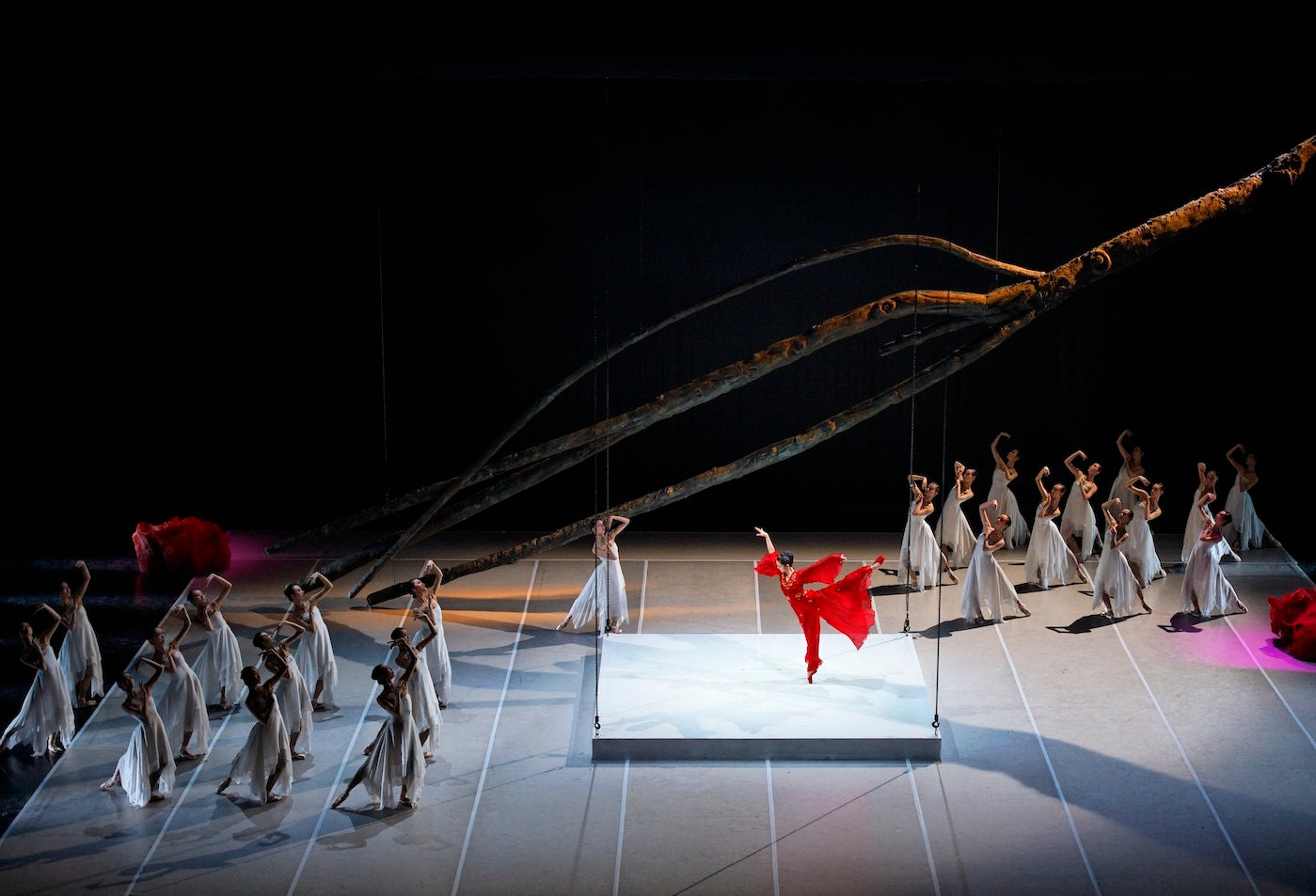
The pavilion, in which Du Liniang falls asleep and dreams of the scholar Liu Mengmei (with whom she falls in love) is a bare structure, its detached peonies large and singular. In one scene they sit like giant pouffes on the stage, in another they are suspended from above. The minimal stage design allows for Bo’s slow, spacious choreography to build a vision of its story. Told in two acts, each of three scenes, a ballet of dreamscapes unfolds. Watching it you experience the same feeling of suspended reality—it's as if the dancers are floating, timeless, through Simon’s sparse landscape.
The graceful movements of the female dancers bring an ethereal quality to the work while the men bring strength and energy. In the fluttering white dresses of the first act the corps are soft and sylph-like, their movement characterised by arabesques, bourées and gentle arms. They appear like a modern day version of the wilis of classical ballet, caught in an ancient Eastern story.
Upon awaking, Du Liniang can’t forget her dream love and, although they have never met, she eventually dies of her unrelinquished passion. Zhu Yan is entrancing as the young Liniang. Her expressive, lyrical style is soft yet dynamic, a combination that perfectly captures the conflict of her demure innocence and awakening desire.
Through the first act this scenario unfurls, Liniang accompanied by her ‘other selves.’ In a red gown, the Flower Goddess Liniang (Zhang Jian) guides Liniang to learn the truth of her desire while Kunqu Liniang, performed by opera singer Jia Pengfei, cautions restraint. Her voice cuts through the delicate movement of Liniang's dreams—and your wandering imagination—with its gleeful ‘eeeee,’ more a nasal sighing sound than song.
Liniang repeatedly returns to her dreams of Liu Mengmei. In one they dance together, a fluid, sensuous duet with a fetishistic twist. Caressing Liniang’s foot, Mengmei removes one of her shoes. It’s the connection that unites the dream lovers and they dance together, a seductive, entwining pas de deux, Yan half en pointe, half barefoot. It's an oddly erotic image and it returns in the second act as the corps enter, each wearing one red pointe shoe. It's a surreal vision that aptly captures the dream-like feel of “The Peony Pavilion.”
Like a dream the scenes shift inexplicably; from the pavilion, to a harvest scene with farm labourers, to the underworld. For Chinese speakers, the words Pengfei sings may help clarify the narrative, but understanding them is not essential. The whirling sense of being led, semi-blind, through this shifting world only adds to its enjoyment.
As the music darkens and grey hued peonies replace the magenta of the opening, we enter the underworld. The dramatic style of opera lends its touch to the music and theatricality of this scene. It breaks the floating charm of the work and stirs up the energy. While you could happily drift through the picturesque world National Ballet of China create, the dynamic shift the underworld scene brings awakens the attention.
The ‘infernal judge’ of the underworld is so moved by Liniang’s plight that he grants her permission to return and be united in marriage with Liu Mengmei—or so I learn from the synopsis. The narrative is not always clear, but this outcome leads to a suitably picturesque finale. The wedding procession heralds a sea of red cloaked bodies, circling en masse upon the stage, a tale of dreams and desire drawing to a close in a curtain of falling petals.
In “The Peony Pavilion” demure, delicate femininity conflicts with desire, tradition melds with a modern landscape. It’s expressive, visually mesmeric and, at times, inscrutable. Yet the fact that you might lose the thread of the narrative along the way somehow matters little. National Ballet of China have created a captivating vision that draws you into the dream world of “The Peony Pavilion.”





comments