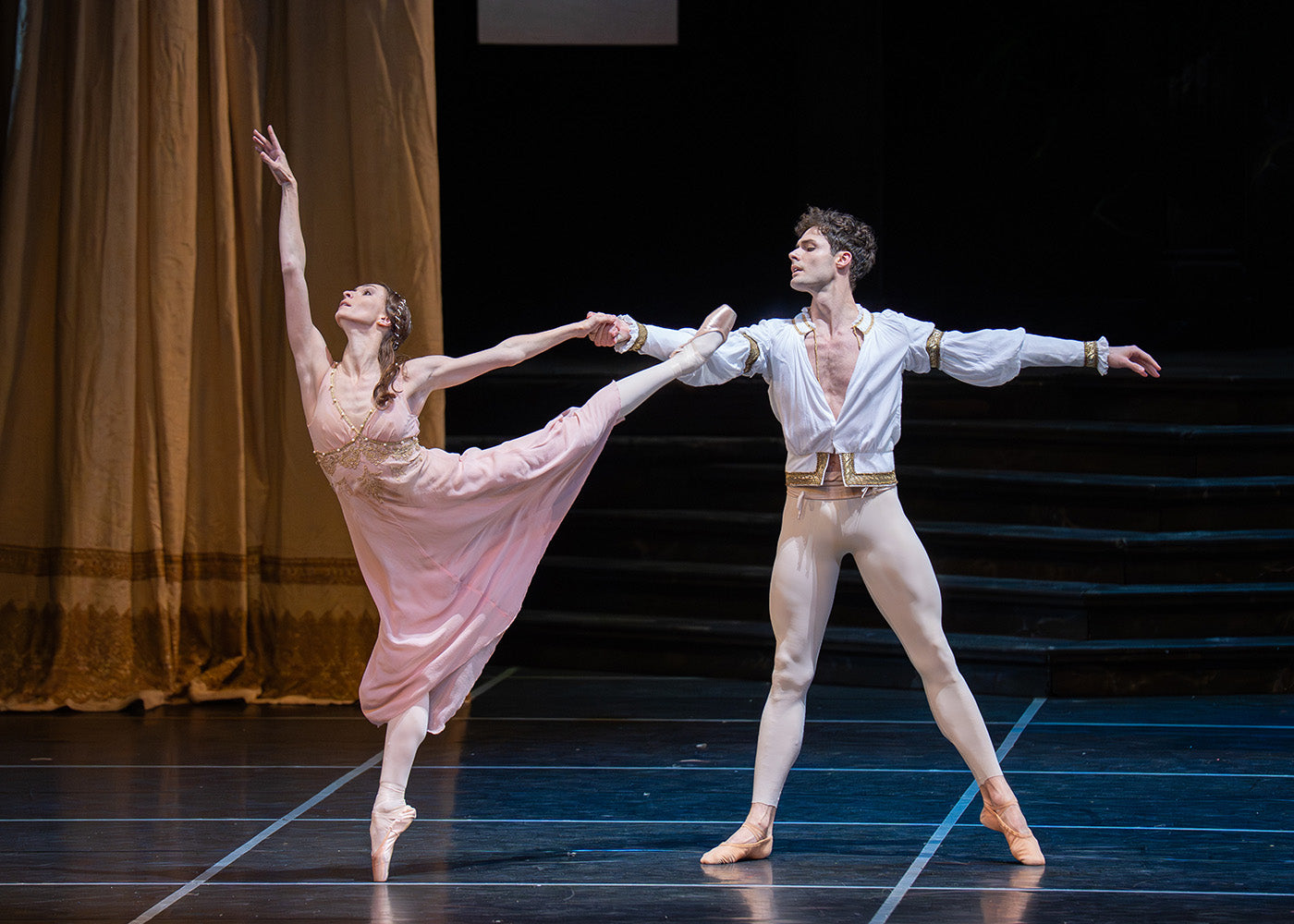
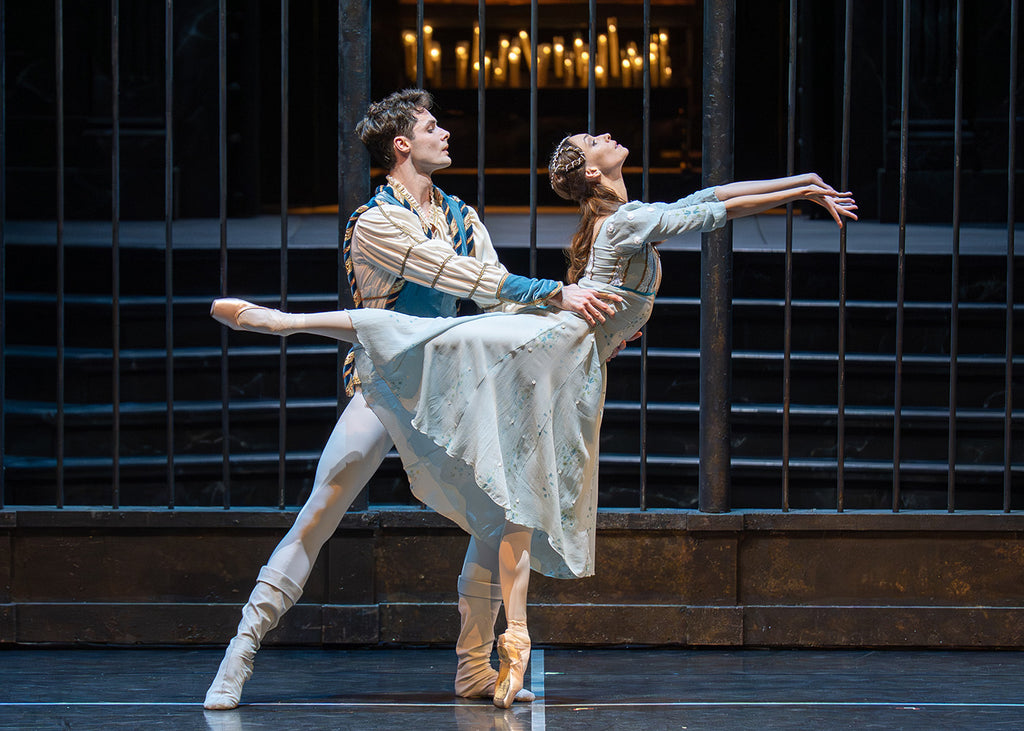
When faced with Paris, her promised groom, and with men in general, Juliet carries a pure, instinctive fear, almost that of a wild creature. She shows a similar retreat when she first meets Romeo, though this time not out of fear but from the depth of her feeling—a sincere and sudden love that Smirnova conveys with disarming delicacy. Tissi’s Romeo is poetic, elusive, lyrical rather than passionate: refined, with impeccable lines and seamless jumps, turns of crystalline precision. Together, he and Smirnova, long in their lines and luminous in their presence, seem to reach toward infinity. In the balcony pas de deux, with the balcony set unusually low, their reverie is interrupted by a comic intrusion that breaks the spell precisely at the musical climax—the moment of highest pathos when, in MacMillan’s version, the lovers are entangled in passion. Here, the plump, anxious maid rushes in to call Juliet back inside, creating a strange dissonance. This device works particularly well to counterbalance the almost unattainable perfection of Smirnova and Tissi—so statuesque, so cool, so unreachable. It proves once again that van Dantzig’s equilibrium between drama and humour, buffoonery and tragedy, is what gives the ballet its humanity.
Van Dantzig’s staging refines the traditional contrast between Romeo’s two friends: the calm, level-headed Benvolio (Joseph Massarelli) and the impulsive, fiery Mercutio (Edo Wijnen) form a delightful counterpoint. Wijnen captivates with his charismatic energy and effortless musicality, his movements imbued with wit and spontaneity. His death scene, when he is struck by Tybalt’s spade and slowly loses consciousness and control of his body, recalls the harrowing, drawn-out deaths of “Giselle” or “La Bayadère”—moments similarly surrounded by the choral despair of the community—and is executed with masterful finesse. Earlier, in the bustling marketplace scene, he playfully mocks a giant skeleton figure (Bela Erlandson); yet even in this moment of humour, the shadow of death already hovers over him, foreshadowing his fate.
Death permeates the production from the very beginning; rather than a rupture, it is conceived as part of the same continuum of vibrant life that animates the streets of Verona. At the opening of the first act, after the initial brawl, two corpses remain onstage, one of them a villager mourned by a woman and child at the edge of the scene, setting a tone of quiet foreboding. In the final act, as Juliet runs through the night to seek Friar Laurence’s help in escaping the marriage arranged by her parents, the ghosts of Mercutio and Tybalt return for a macabre pas de trois with her—an eerie and original invention by van Dantzig that seals the ballet’s vision of existence as a perpetual dance between life and death, this world and the next.





comments