Ce site Web a des limites de navigation. Il est recommandé d'utiliser un navigateur comme Edge, Chrome, Safari ou Firefox.

Down the Rabbit Hole

It is a kaleidoscope of references, a whirligig of Alices, I carry with me to the third Melbourne season of Christopher Wheeldon’s “Alice’s Adventures in Wonderland,” presented by the Australian Ballet, at the State Theatre in Melbourne. They mingle in the ether with the Alice conjured direct from my own reading of the Lewis Carroll classic, and the memory of that encounter. From Lauren Cuthbertson in 2017 to Ako Kondo and Amber Scott in 2019, in 2024, my Alice guides are Sharni Spencer and Benedicte Bemet, on the Tuesday and the Wednesday nights, respectively. Each Alice within the tale shapes the role accordingly, and so Spencer’s gentle and trusting of the “wildest impossibilities” Alice, and Bemet’s joyful and “wildly curious” Alice form a magical gallery of Alices who I follow about the stage as they in turn follow a twitching, scurrying, quick-changing White Rabbit.[1]

Performance

The Australian Ballet: “Alice’s Adventures in Wonderland” by Christopher Wheeldon

Place

The State Theatre, Arts Centre, Melbourne, Australia, March 19 & 20, 2024

Words

Gracia Haby

Benedicte Bemet in “Alice's Adventures in Wonderland” by Christopher Wheeldon. Photograph by Christopher Rodgers-Wilson

Leaning upon a dodo for support, who finds the best way to explain a caucus race “is to do it”, so, too, a means to make a book of wordplay into a ballet: just do it, and in the doing, the story unfurls, for both are read, and both can spark imagination. Running about in a circle to dry off, the dodo soon proclaims: “EVERYBODY has won, and all must have prizes,” which is essentially how I feel about the perfectly ridiculous “Alice” where movements, like words, to borrow now from Carroll himself, mean more than we mean to express when we use them. Coincidentally, this race-over “Alice” is the last performance to grace the stage at the State Theatre, before it closes for a three-year refurbishment. But we’re not over yet.[2] No, we’ve only just begun. 

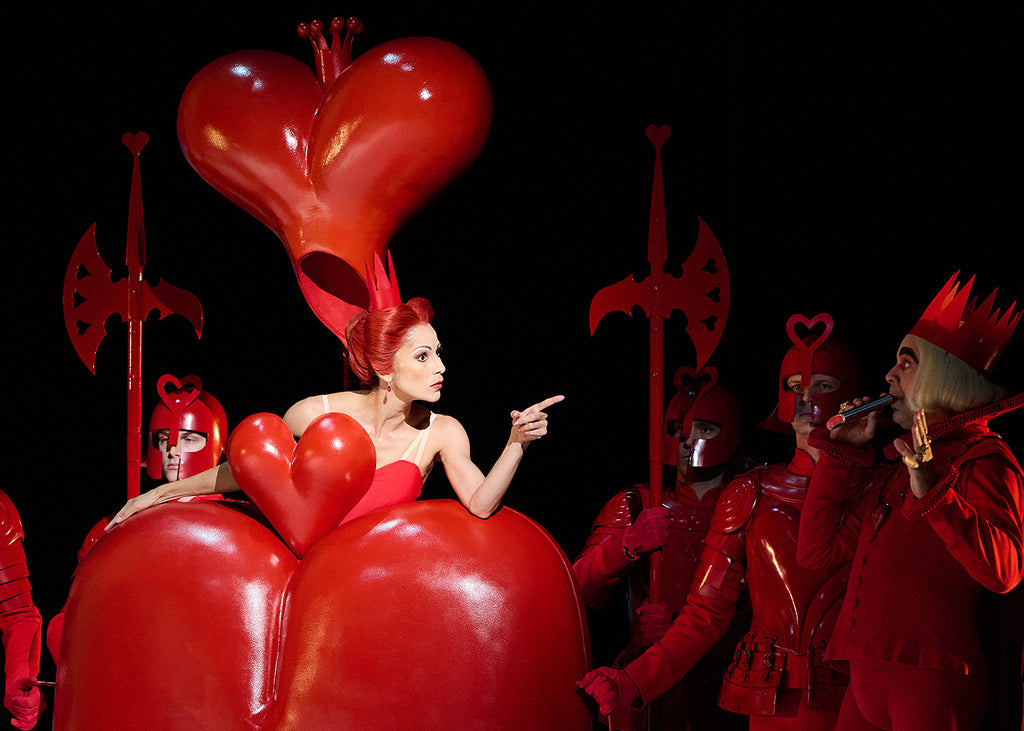
Then and now, Wheeldon’s open-hearted, playful invitation to fall down the transformative burrow is one I willingly accept. Of course, there’s a Frog Croaking Guiro, in which a stroke of the back of the percussive instrument makes a series of croaks, in there! And just as Bemet explains that you need to lean into the comedy and find some peculiar physicality,[3] this is true of the role I am accepting in the audience. This time, I have the good fortune to see Jarryd Madden transform not just in the conventional magical narrative of from a gardener named Jack to a Knave on the run, but from a tapping Mad Hatter too; with Joseph Caley filling the gardener’s boots on the following night, and both Madden and Caley imbuing the role with grounded tenderness. Robyn Hendricks, who is also inhabiting the role of Alice this season, is on Tuesday night both Alice’s Mother and heart-entombed, precision-tanked Red Queen magnificence, with Ako Kondo also controlling and devouring the role the following night. Disappearing to reappear, Brett Chynoweth and Chengwu Guo split the part of Lewis Carroll in the gardens in 1862 and spring-footed, ever-alert White Rabbit with conviction more than fur deep, but to the marrow. Drew Hedditch assumes the role of Hatter, Tuesday, and sequined Fish air-swimming the following. Such things, though part of the regular course, seem to give a slippery toehold to the theatrical sense of a landscape always changing; where things look the same until they are not; where flamingos are mallets and hedgehogs are balls in a game of croquet, and Home Sweet Home belies a butcher’s block macabre; where a floral waltz hits woozy notes of off-centred hallucinogenic states.[4]

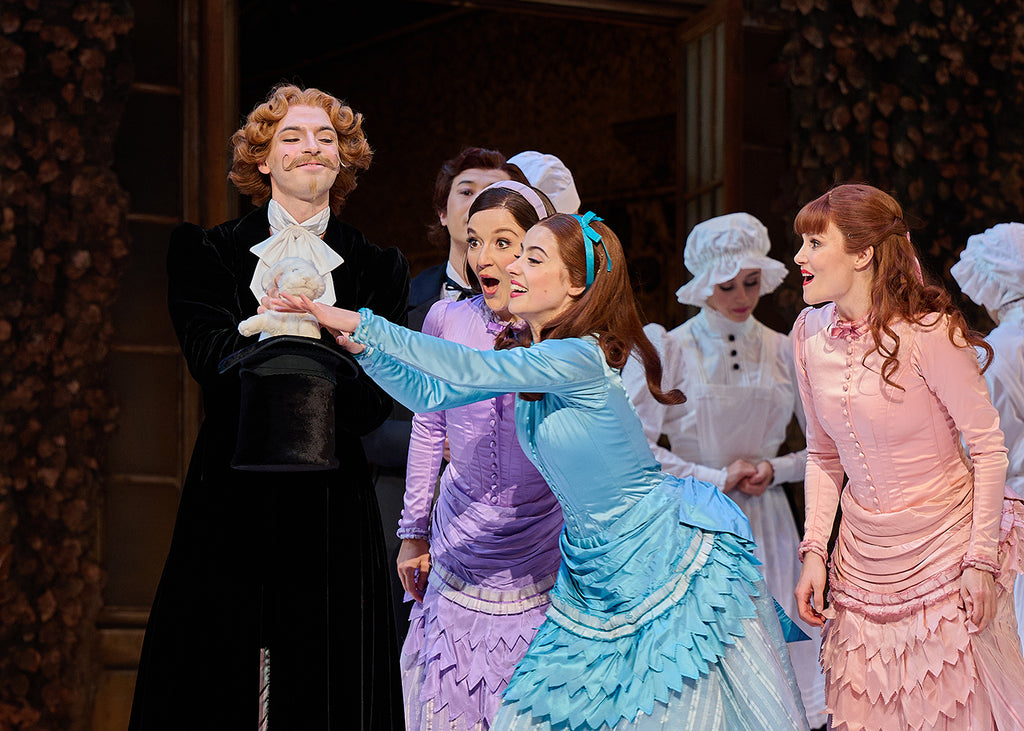
Benedicte Bemet, George-Murray Nightingale, Lilla Harvey and Jade Wood in “Alice's Adventures in Wonderland” by Christopher Wheeldon Photograph byChristopher Rodgers-Wilson

Benedicte Bemet, George-Murray Nightingale, Lilla Harvey and Jade Wood in “Alice's Adventures in Wonderland” by Christopher Wheeldon Photograph byChristopher Rodgers-Wilson

This tumble is a fast-paced jumble in the familiar, that delights in juxtaposing the quiet moments of Alice’s beautiful “all alone” solo with the levity of the Caucus race that follows. Never settling in one state for too long, as typified by the brevity of the Caterpillar’s shimmering, telescoped-forward locomotive wave of contraction-relaxation (encapsulated by soon-to-be retiring, senior artist Nathan Brook, on Tuesday, and newcomer, soloist Davi Ramos, Wednesday), and Alice’s mid-air suspension, clock-face canter with the Hatter, March Hare, and Dormouse. Time is sped up, and suspended, as much as belief in the possible-impossible, as a Dormouse warms their paws by the spout of a teapot, and Alice recoils at the wild smell of a March Hare’s foot (perfectly ordinary), and impossible-possible, as Alice joins the White Rabbit in a paper boat that glides past a landscape in silhouette, in a tipping of the creative cotton spool of a hat to Lotte Reiniger (perfectly extraordinary). 

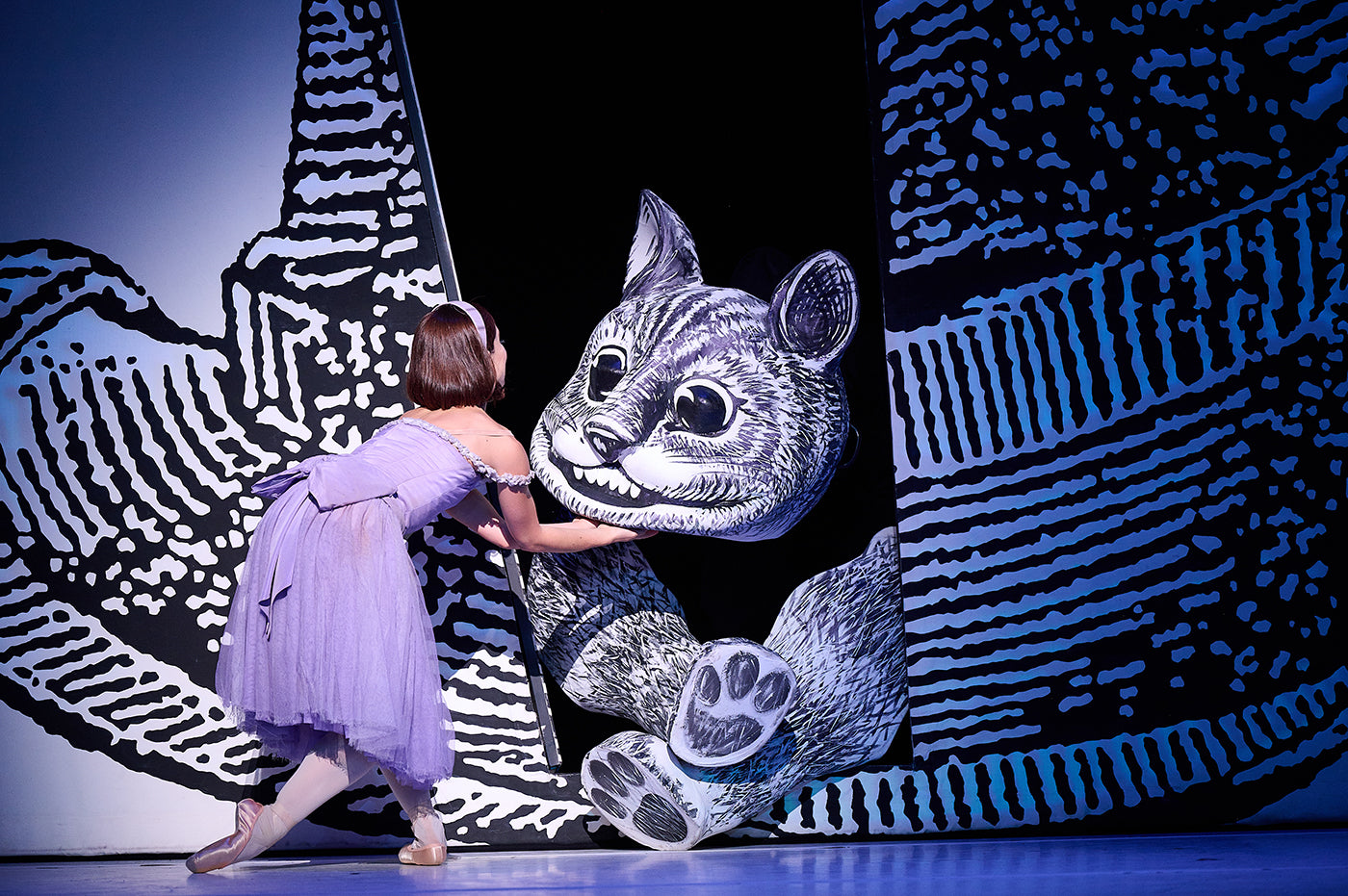
The Cheshire Cat of assembled parts floats into view, quivers as Alice runs through his series of bobbing parts, and leans his head forward as Alice stokes him beneath his chin. Drawn from reality and separate from it, as befits a dream-state meet, Toby Olie’s Cheshire Cat puppet all but purrs a perfect fit. Having barely scratched the surface, “Alice,” all, feels so effortless yet full of spectacle, quiet and loud, big and small, sharp and blurred, ever shapeshifting in the blink of a Cheshire Cat’s wink. 

Robyn Hendricks and Steven Heathcote in “Alice's Adventures in Wonderland” by Christopher Wheeldon. Photograph by Christopher Rodgers-Wilson

Robyn Hendricks and Steven Heathcote in “Alice's Adventures in Wonderland” by Christopher Wheeldon. Photograph by Christopher Rodgers-Wilson

Changing the proportion of things, with outward ease, is epitomised by the optical illusion of Alice’s“‘Drink Me” tiny, “Eat me” giant scene, with thanks to a small motorised door that slides across the stage in eight counts, a pair of long legs and arms that descend from the rafters, and the whole-heartedness of Spencer and Bemet as their forms contract and lengthen, seemingly beyond their control. As Alice later lifts her form from the floor to avoid dampening her dress in a pool of her own tears, of course I believe. The Piero Fornasetti face of Lina Cavalieri sheds a tear, before being submerged and spilling into silhouette. Alice dips her hand through the screen before she, too, spills into silhouette. Over in a where to look!? flurry.

Gracia Haby


Using an armoury of play and poetry as a lure, Gracia Haby is an artist besotted with paper. Her limited edition artists’ books, and other works hard to pin down, are often made collaboratively with fellow artist, Louise Jennison. Their work is in the collections of the National Gallery of Australia and state libraries throughout Australia to the Tate (UK). Gracia Haby is known to collage with words as well as paper.

footnotes


  1. Lewis Carroll’s descriptions of the qualities of Alice, written in reaction to a stage play, “Alice” created from his book, and published as “‘Alice’ on the Stage”, in The Theatre, edited by Clement Scott, London: Carson and Comerford, April 1887.
  2. “Reimaging” Arts Centre Melbourne, https://www.artscentremelbourne.com.au/about-us/reimagining, accessed March 18, 2024.
  3. Benedicte Bemet on her role of Alice in “Our favourite “Alice’s Adventures in Wonderland” moments” The Australian Ballet, https://www.youtube.com/watch?v=dMCLGrmTAKU, accessed March 21, 2024.
  4. Christopher Wheeldon describing the chromatic steps within Talbot’s waltz as being “slightly wrong, so it would feel a bit hallucinatory”, ‘Easter Eggs and Rabbit Holes’, Rose Mulready, “Alice’s Adventures in Wonderland©” Sydney and Melbourne 2024 programme, The Australian Ballet, 12.
  5. “Meet the team behind the sets of “Alice’s Adventures in Wonderland,” The Australian Ballet, https://www.youtube.com/watch?v=LFfP8PqnkLc, accessed March 18, 2024.

subscribe to the latest in dance


“Uncommonly intelligent, substantial coverage.”

Your weekly source for world-class dance reviews, interviews, articles, and more.

Already a paid subscriber? Login

comments

Veuillez noter que les commentaires doivent être approvés avant d'être affichés

Featured

Five Remembrances of a Benefactor
Obituaries | Rachel Howard

Five Remembrances of a Benefactor

The way Margaret Jenkins tells it, Dianne came to her dance company’s studios in 1973, asking to take class. Dianne was then living in a one-bedroom apartment near San Francisco’s Mission District with her scientist husband and three young kids.

FREE ARTICLE
Oceans Apart
REVIEWS | Kris Kosaka

Oceans Apart

Waiting in the theater, the first unhurried trickle of French composer Erik Satie’s piano variation barely registers amidst the house chatter. Sparse and minimalistic, swelling with silences, the striking keys eventually conjure up a dancer.

Plus
Timeless Terrain
REVIEWS | Elsa Giovanna Simonetti

Timeless Terrain

“When you visit Kati Thanda–Lake Eyre, you realise that this is a place where time does not exist,” writes choreographer Frances Rings in her notes for Terrain, and the resonance with Wayne McGregor’s theme for the 2026 Biennale Danza, Time Does Not Exist, is unmistakable.

Plus
All About Love
REVIEWS | Rebecca Deczynski

All About Love

It starts out light and coquettish. George Balanchine’s “Sonatine,” set to the composition by Maurice Ravel of the same name, is undeniably lighthearted, as the dancers—here, Léonore Baulac and Germain Louvet—find themselves animated by the music, as they share the stage with a grand piano (and pianist Elena Bonnay at its helm).

Plus
Good Subscription Agency