Ce site Web a des limites de navigation. Il est recommandé d'utiliser un navigateur comme Edge, Chrome, Safari ou Firefox.

Dance on their own Terms

For its upcoming New York City Center season (April 23-26, 2026), Ballet Hispánico New York will present “Mujeres: Women in Motion,” programming that centers on Latina women who are shaping the language of dance. Artistic director and CEO Eduardo Vilaro explained, “This is our third installation of uplifting the voices of Latina choreographers. From our first programmatic installation in 2016, to the second in 2019, and now with our third in 2026, we are committed to equalizing the power structure that has privileged male-dominated leadership in dance. Ballet Hispánico has championed this movement for many reasons—but primarily, we were founded by Latina educator and performer Tina Ramirez.”

Stephanie Martinez, Annabelle Lopez Ochoa, Marianela Boan, and Cassi Abranches, choreographers for Ballet Hispánico's program, “Mujeres: Women in Motion.” Photograph courtesy of Ballet Hispánico

Ramirez established the company to provide opportunities for Latinx dancers and choreographers, while celebrating Hispanic and Latino cultures through dance. Honoring the company’s mission as a beacon of the diversity of Latinidad, Vilaro sought out four female choreographers from different countries, who carry in their bloodline an even greater variety of lineages. 

I spent last week in the company studios (located on Ballet Hispánico Way on Manhattan’s upper west side) observing rehearsals and in the Zoom room with the choreographers—the “Mujeres,” who are shaping the language of dance for this season and for company’s all over the world. Their dances and their words tell a multiplicity of stories from distinct perspectives: 

Cassi Abranches, from São Paulo, Brazil, has choregraphed a vibrant new work for the company titled “Trança” (pronounced trenssa and means “Braid”). Abranches has been resident choreographer with Grupo Corpo since 2024 and a leading figure in Brazilian contemporary dance. Having danced with Grupo Corpo from 2001 to 2013, she has since made three works for the company and choreographed for other major ensembles in Brazil and abroad. 

Abranches shared her inspiration for this commission:

When Eduardo invited me to choreograph for this beautiful company, I was looking for a way to merge Brazilian, Latino, and American influences that we were bringing together—like in a braid. I invited the amazing Brazilian composer and producer, Beto Villares to compose a soundtrack. I am Brazilian. So when I start to create, naturally, the Brazilian energy and spirit is my inspiration. Of course, I have contemporary movement and classical ballet in my body because we practice everything at Grupo Corpo. But at the core, I have this Brazilian blood and soul. We are a culture that dances all the time—at Carnaval, parties, and other occasions. We are always dancing.


Ballet Hispánico in rehearsal for Cassi Abranches's “Trança.” Photograph courtesy of Ballet Hispánico 

Ballet Hispánico in rehearsal for Cassi Abranches's “Trança.” Photograph courtesy of Ballet Hispánico 

The music provides the acoustic impulse for the dance, moving across Indigenous and Afro-Brazilian roots, rural and urban rhythms, and electric and organic textures. In the studio, Abranches coaxes the dancers into the subtleties of the movement style—relaxed, agile syncopations; earthy groundedness; percussive precision. One moment she prods the dancers into percussive isolations throwing their sternum forward and back like a primal heartbeat. In the next, she refines a Carnaval sequence—leading a group of men in a samba step as she coaches them into its cool, understated, sensuality. The men samba forward, weaving through a jazzy trio of women. Trança” weaves a pulsing tapestry of comings and goings that vibrate with outer and inner motion.

Marianela Boán is an internationally recognized choreographer, a leading creative force in the Cuban and Latin American dance avant-garde. After dancing with the National Ballet of Cuba and the company Danza Contemporánea, Boán founded her Havana-based company DanzAbierta in 1988 to evolve her performance style, which she calls “contaminated dance.” She described this idea saying:

I live in the Caribbean. We are a melting pot—a mixture of cultures and origins. Nothing is pure here. I wanted a form that would allow me to use dance along with everything else to express ourselves. So this is dance that is contaminated by all the arts—including theater, painting, music, poetry, objects—whatever we need. This was my response to living in a very closed society—Cuba, a communist society. So I founded my company Open Dance in 1988, and I started investigating and mixing elements in my choreography to address the prohibited topics I wanted to talk about in this closed society. The idea of “contaminated dance” allowed me to open questions that violated the censorship. 

Ballet Hispánico in rehearsal for Marianela Boán's “Reactor Antígona.” Photograph courtesy of Ballet Hispánico 

Ballet Hispánico in rehearsal for Marianela Boán's “Reactor Antígona.” Photograph courtesy of Ballet Hispánico 

Boán is now based in the Dominican Republic and leads Marianela Boán Danza, through which she continues to evolve her multi-disciplinary process. She positions dance as “declaration rather than decoration” with her bold creations presented at major festivals and venues worldwide. As an educator, she has shaped generations of dancers across the Americas and Europe. 

Boán’s distinctive work for this season, “Reactor Antígona” (Reacting to Antigone), explodes the Greek drama “Antigone” condensing the characters to a cast of three and re-imagining the narrative. Boán put two stuffed, army green duffle bags in the dancers’ hands and allowed the props to dictate the movement creating a powerful physicality. The action takes place on a stage covered with fallen leaves. Boán explained the symbolism behind these choices:

I used these big duffle bags in the piece because that’s what Cubans use when they emigrate. These characters in the Greek tragedies are always on the move—migrating—just like the Caribbean people. They are all immigrants. As for the leaves, I imagine they are always there as these people keep moving from place to place. They signify an exterior space in the open air. And they are so beautiful—their sound and their movement.

Rehearsal for Stephanie Martinez’s “Otra Vez, Otra Vez, Otra Vez.” Photograph courtesy of Ballet Hispánico

Rehearsal for Stephanie Martinez’s “Otra Vez, Otra Vez, Otra Vez.” Photograph courtesy of Ballet Hispánico

Stephanie Martinez, a compelling choreographer based in Chicago, has created numerous works for companies across the United States including Joffrey Ballet, BalletX, Charlotte Ballet, Kansas City Ballet, and many others including theater and opera companies. In 2020, Martinez founded Para.Mar Dance Theatre, where she serves as artistic director. Her dance language is a mix of contemporary movement rooted in but not confined to ballet with a strong dedication to honest storytelling and rigorous dramaturgy. 

Ballet Hispánico will dance Martinez’s work, “Otra Vez, Otra Vez, Otra Vez,” an imaginary narrative sparked by Picasso’s self-portrait, “The Old Guitarist.” Martinez recounted her thought process in generating the piece:

I was obsessed with Picasso’s The Old Guitarist. That painting holds him in such restraint within the frame. Who was he before he was encapsulated in this autobiographical picture? He looks like he was toward the end of his life, but he had a life before he was old. If I opened the painting up, what would that look like? Who are the people that he loved and lost? In the ballet, some of the characters interact with their younger selves. I did some stringing and sewing down memory lane of my own stream of consciousness—imagining a loose narrative from my Mexican, Catholic background growing up in El Paso, Texas. 

Antonio Cangiano and Amanda del Valle in “Línea Recta” by Annabelle Lopez Ochoa. Photograph by Steven Pisano

Antonio Cangiano and Amanda del Valle in “Línea Recta” by Annabelle Lopez Ochoa. Photograph by Steven Pisano

The scenes from this opened up canvas flow with a musical physicality tinged with evocative color and nuance. Martinez shared, “The music became an emotional architecture. I worked with a collage of Latin music that holds the weight of memory, longing, and resilience—a lot of songs I used to listen to when I was young … with my grandmother.” The music is saturated with emotional immediacy and gritty rawness, which Martinez matches with her choreography of loose, supple torsos “upstairs” (peppered with an occasional ceremonial gesture) and precise pointe work “downstairs.”  The work lives between control and release—an engaging tension.

For Ballet Hispánico regulars, Annabelle Lopez Ochoa needs no introduction with so many of her works in the company’s repertory. Vilaro first commissioned the Belgian-Colombian choreographer to make a piece for the company in 2010. She came back in 2016 to create “Línea Recta,” which will be presented in this season’s programming.

Lopez Ochoa is a much in-demand ballet choreographer with commissions from New York City Ballet, San Francisco Ballet, English National Ballet, and Dutch National Ballet, among many others and is currently resident choreographer at the Dortmund Ballet in Germany since 2025. She credits Vilaro as the first person to ask her to choreograph something about her roots saying, “I thought that I needed to look like the choreographers around me, William Forsythe, Jiri Kylian, handsome men. Those were the people in Holland. And here comes this request for something about my roots. That opened a whole new source of inspiration. And the reaction of the audience was amazing.” 

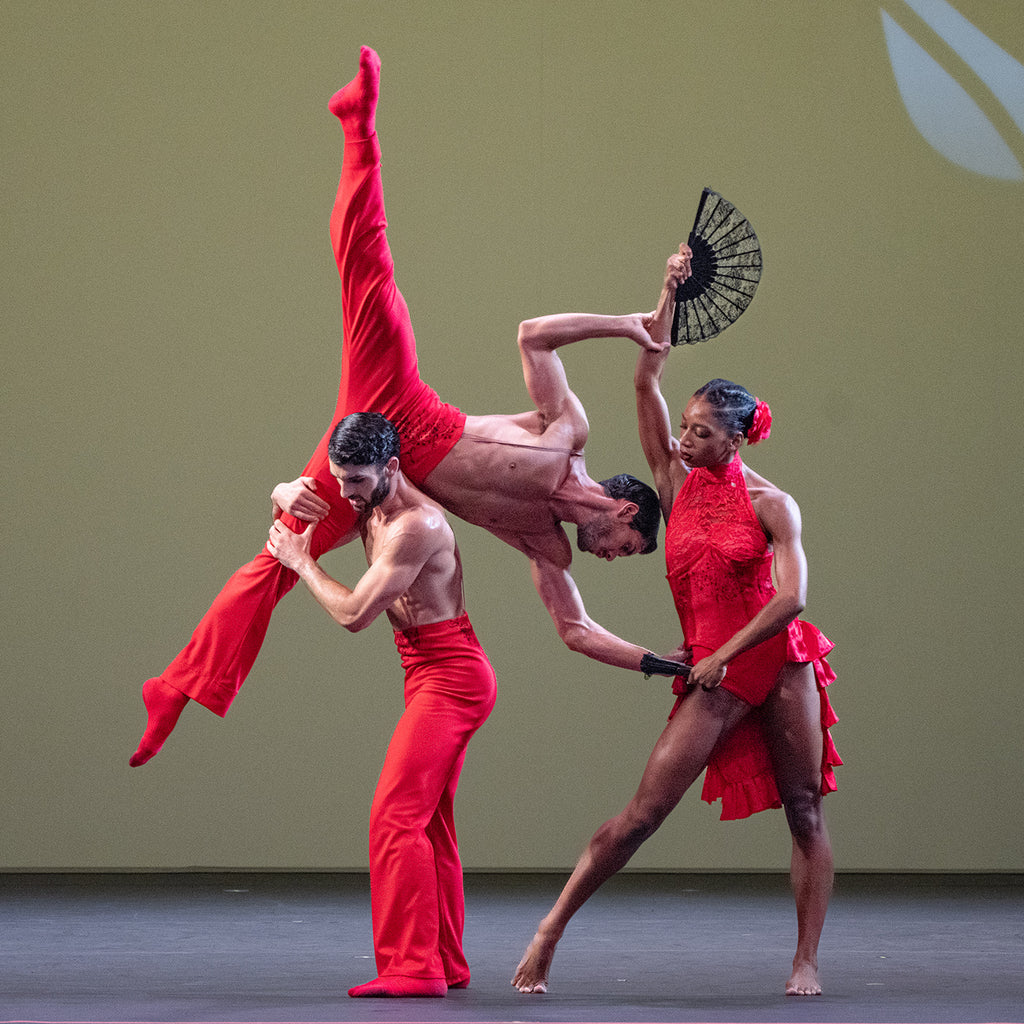
“Línea Recta,” inspired by Lopez Ochoa’s love of Flamenco from her years of training in the form, is a dramatic fusion of Flamenco movement and contemporary ballet that sizzles with passionate intensity and sports a fabulous long, red skirt. She reflected about her inspirations for the piece:

I wanted to explore this Spanish dance form that I grew up with because I love it. I had just been working at New York City Ballet, and I wanted to carry over that sense of beauty. Now Flamenco has no partnering. There’s a lot of tension—sexual tension—between the man and the woman. But they communicate through zapateados (tapping footwork), palmas (rhythmic handclapping) and through moving around each other. They never actually touch each other. So I wanted to capture that tension but fuse it with a classical vocabulary so that we could create beautiful lines and include partnering.

 Ballet Hispánico in “Línea Recta” by Annabelle Lopez Ochoa.

Ballet Hispánico in “Línea Recta” by Annabelle Lopez Ochoa.

Contrary to traditional Flamenco, where relational tension is created through indirect means, Lopez Ochoa went for a direct line (Línea Recta). She liberated the dance form and its contained tension with a profusion of delicious partnering.

With “Mujeres: Women in Motion,” Ballet Hispánico has tapped an exciting group of accomplished Latina dancemakers from all over the world. They define dance on their own terms. And they have much to say.

Karen Greenspan


Karen Greenspan is a New York City-based dance journalist and frequent contributor to Natural History Magazine, Dance Tabs, Ballet Review, and Tricycle among other publications. She is also the author of Footfalls from the Land of Happiness: A Journey into the Dances of Bhutan, published in 2019.

subscribe to the latest in dance


“Uncommonly intelligent, substantial coverage.”

Your weekly source for world-class dance reviews, interviews, articles, and more.

Already a paid subscriber? Login

comments

Veuillez noter que les commentaires doivent être approvés avant d'être affichés

Featured

Dance on their own Terms
FEATURES | Karen Greenspan

Dance on their own Terms

For its upcoming New York City Center season (April 23-26, 2026), Ballet Hispánico New York will present “Mujeres: Women in Motion,” programming that centers on Latina women who are shaping the language of dance.

Plus
Bright Stars
REVIEWS | Rebecca Deczynski

Bright Stars

Misty Copeland makes an observation. “I see,” she says, looking into the audience packed with attendees in formalwear, “a lot of people who care about ballet.” 

Plus
Strings Section
REVIEWS | Rebecca Deczynski

Strings Section

Chamber music can be fun, too! That, at least, is the apparent message that violinist Johnny Gandelsman is trying to spread in his two-hour program, “Johnny Loves Johann.” He’s certainly not wrong.

Plus
For Old Times’ Sake
REVIEWS | Rebecca Deczynski

For Old Times’ Sake

What makes a story stick across not just decades, but millennia? The longevity of ancient Greek drama points to an innate essentiality, but the variations of these works, too, have played a critical role in its durability.

Plus
Good Subscription Agency