
Shakespearean Twist
It’s a drag to report that I had the urge to walk out of my first performance back in NYC after a long summer break.
Continue Reading

World-class review of ballet and dance.
In 1975, Laura Mulvey first came up with the term “the male gaze,” where the assumption, particularly within the media, was that those consuming and watching most art forms were male, or male identifying, hence the need for women being represented as mere window dressing and sexually appealing objects. This was largely ubiquitous in film, art, pop videos and on fashion runways—even in dance productions. However, with strides being made in contemporary society in recognising that gender is largely a construct, and that it's no longer about male and female, but rather than gender can also be trans, fluid and/or non-binary, said male gaze is becoming increasingly redundant and reductive. With choreography from Marne and Imre van Opstal, Eye Candy for Rambert plays with this idea.
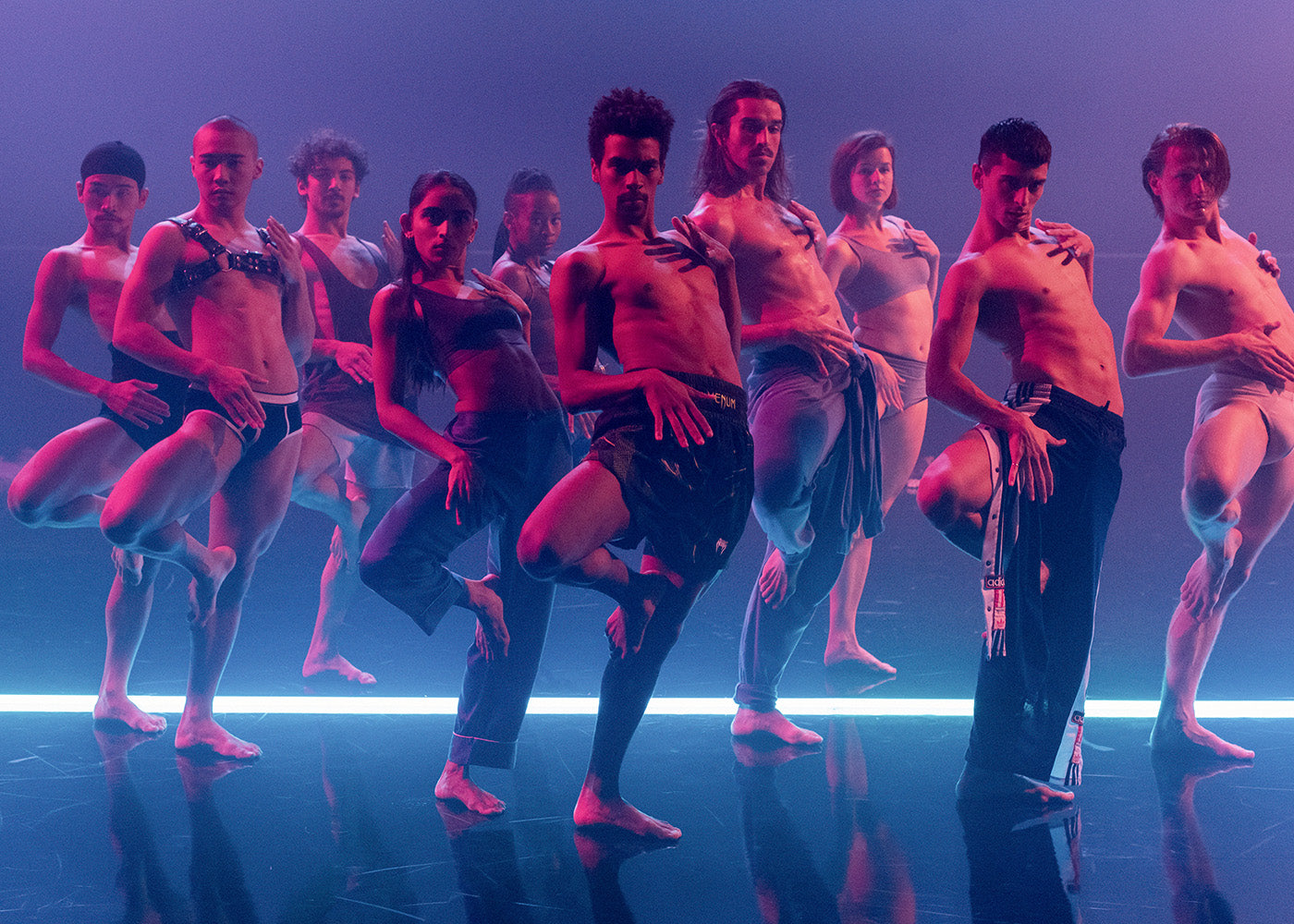
Rambert in Marion Motin’s “Rouge.” Photograph by Camilla Greenwell
It begins almost like a homage to Pina Bausch's provocative Kontakthof, where a female dancer was poked at and grabbed by male dancers. Aishwarya Raut is a curvaceous dancer and woman of colour. Semi nude, she is prodded at, her head turned this way and that, and torso grabbed and (man)handled, a commodity, treated like a puppet by the male and male identifying dancers. Yet, she remains oddly impassive, her expression and stance revealing nothing. Only (the external) body parts are exposed.
More and more male dancers appear, balancing and holding Raut aloft, and the starkness of the set and flesh colured costumes (also created by the choreographers) render the bodies curiously lifeless and othered. They pile up like a human sculpture, a form of flesh and bone, and then dismantle, propelling Raut forwards, and her stomach flexes as though she's something alien.

Now, the company of eight become like pagan worshippers, hands raised in defensive claws, predatory. Accusatory fingers are pointed, but at whom, and why? There is a sense of ambiguity to the piece, and the figures, swaying or joining hands in a circle, are like some festival of sun god/dess worshippers, but with an underlying tone of bucolic love and peace undone. Amos Ben-Tal's sound goes from dripping water to ragged breathing and drones, and sudden crouching down is suggestive of defence mechanisms. I am frequently reminded of the darker side of cults in horror cinema, such as The Wicker Man, and more recently, Midsommar, where idyllic heathen life is more sinister than it first appears.Only the pas de deux towards the end gives any kind of reassurance of equality between all genders, with its blue abstract background and glimpses of exquisite tenderness. But what a bumpy ride to get there.
Much more conventional in its structure, but no less exciting, is Marion Motin's Rouge. Nothing to do with the Moulin Rouge, this particular Rouge is firmly rooted in the here and now, with an interweaving of modern styles, such as hip hop, reggaeton and contemporary. A French choreographer who began in hip hop, who has worked with the likes of Christine And The Queens, Jean Paul Gaultier and Dua Lipa, she's all about transcending styles and boundaries. With sexy neon lighting and strobes from lighting designer Judith Leray, this piece invokes the exhaustive, freestyle energy of both the street, and the dancefloor alike. At first, as an almost cinematic smokescreen clears, the dancers rise, fall, rise, fall and then . . . it all kicks off. It's fierce, fun and playful, relentlessly athletic, and the ten dynamic dancers' bodies, swathed in vibrant pinks and blues- flexing, popping and grinding, almost androgynous in Yann Seabra's specially designed slinky sportswear- will definitely make many of the audience watching at home long to get out into real nightclubs again.

There are also some lively, updated nods to ball culture here, where LGBTQI dancers competed in the disco era for best “houses,” in categories like “realness,” “femme queen,” “legendary” and “virgin vogue,” often using exaggerated gestures with hands and footwork, parodying models on catwalks.
Ball culture, otherwise known as ballroom or drag ball culture, has seen a recent resurgence in art galleries and in clubs over the last few years, thanks to the TV series Pose, and the twenty first century take on ballroom is categorised by even more complex poses, flamboyant clothes, gestures and the kind of “wild style” spins and flips on the floor not seen since all-nighters in the seventies and eighties.
So it seems apposite that Motin has revitalised this kind of choreography within a live performance context, as the world tentatively decides whether or not to open up again, in these strange times of the pandemic. There may be dry ice, loud rawwwk guitar music from composer Micka Luna, and the sweat-drenched glamour of the club scene, but these wonderful humans, the seemingly inexhaustible Rambert, remain front and centre of it all.
“Uncommonly intelligent, substantial coverage.”
Your weekly source for world-class dance reviews, interviews, articles, and more.
Already a paid subscriber? Login
It’s a drag to report that I had the urge to walk out of my first performance back in NYC after a long summer break.
Continue Reading
Things seem to be clicking in place for Mamela Nyamza. Her latest work “The Herd/Less” is touring the world while her recognition as a choreographer with a distinction for the subversive and political has earned her a Silver Lion for dance at the Venice Biennale.
Continue Reading
After taking a field trip in the second grade to see the Alvin Ailey American Dance Theater, Ronald K. Brown was inspired to take his first dance class at Bedford Stuyvesant Restoration Corporation, a Brooklyn-based community center.
Continue Reading
As much as it is a cliché to reference, there is something special in finding a work that so aptly fits that famous quote from George Balanchine: “See the music. Hear the dance.”
Continue Reading
comments