
Dancing Your Way Home
As the Nor’easter wreaked havoc along the Mid-Atlantic seaboard, the wet winds calmed down enough by late Saturday afternoon to venture out to Alonzo King Lines Ballet that evening.
Continue Reading

World-class review of ballet and dance.
The “Nutcracker” has a way of feeling magical year after year. But something new is always welcome—especially as the ballet has long perpetuated cultural stereotypes. In “The Gift,” Boston Ballet drastically reinterprets the “Nutcracker,” and in doing so, proves that the ballet’s holiday magic extends beyond just its storyline and costumes.
Performance
Place
Words

Boston Ballet in “The Gift.” Image courtesy of the company
Boston Ballet’s “The Gift,” an hour-long performance filmed last year, is different from the traditional “Nutcracker” in most aspects. There is no story of a young girl being whisked away on a journey in her dreams after a Christmas party. There are no spectacular stage sets and costumes to help visualize that journey. But what remains—well-choreographed ensembles and legendary jazz musician Duke Ellington’s rearrangement of Pyotr Ilyich Tchaikovsky’s traditional melodies—convey the same sense of festivity.
The only trace of the traditional “Nutcracker” in “The Gift” is the grand pas de deux, danced by principal dancer Viktorina Kapitonova and soloist Tigran Mkrtchyan. In the traditional “Nutcracker,” this grand pas de deux marks the conclusion to the ballet. But in “The Gift,” it is only the beginning. It is as if the audience is watching a modern extension of the traditional “Nutcracker” that resides in the minds of many.
Following the pas de deux, the ballet then pivots to lively contemporary pieces set to jazz pianist and composer Duke Ellington’s 1960 album “The Nutcracker Suite.” The jazz renditions of Tchaikovsky’s original score, arranged by Ellington and fellow musician and composer Billy Strayhorn, exaggerate the exuberance in Tchaikovsky’s melodies.
The music sets the scene for a ballet far bolder than the traditional “Nutcracker.” “Toot Toot Tootie Toot,” traditionally the “Dance of the Reed Flutes,” is performed in flamenco skirts and character shoes. The music for the “Dance of the Sugar Plum Fairy” is played in a lower pitch for “Sugar Rum Cherry,” a sultry number performed on a dim stage.

These pieces were all ensembles packed with partnering, floorwork and formations. The movement was constant, more than compensating for the lack of visual interest otherwise in their plain costumes and backdrops. The dynamic atmosphere in the ballet can perhaps be attributed to the collaboration present throughout the work. Every section was created by a different dancer, including young artists like Gabriel Lorena, a Boston Ballet II member, and Arianna Hughlett, a postgraduate from the Boston Ballet School.
And in the case of “Arabesque Cookie,” which is traditionally the “Arabian Dance,” there were five choreographers—not just one. “Arabesque Cookie” was the only section of the ballet that wasn’t an ensemble. Here, five dancers danced one after another—each performing choreography by one of the other dancers. In most versions, the “Arabian Dance” is the slowest of the routines in the “Nutcracker” and is filled with sustained extensions.
“The Gift,” however, turns this typically unhurried section of the ballet into an exciting juxtaposition of movement qualities. Artist My’Kal Stromile opens “Arabesque Cookie” by facing the audience for the melody’s first notes, before melting into small, angular movements that culminate in an arabesque derrière. The choreography, by principal dancer John Lam, plays off of the added percussive beat in Ellington’s music.
Second soloist Haley Schwan then dances to Stromile’s choreography, performing with a very Balanchine-esque manner of filling space. Lam finishes the piece dancing to Schwan's choreography, closing out a full circle of collaboration.
The teamwork in “The Gift” comes across in the joyous final result. At its core, part of the “Nutcracker” excitement is simply watching dancers on stage move together in lively ensembles to Tchaikovsky’s famous melodies, whether in their original form or Ellington’s arrangement.
While the storyline and fairytale colors that come along with the traditional version might have been missed, “The Gift” still felt deeply festive. And amid the long overdue conversations about creating an updated, culturally sensitive “Nutcracker,” “The Gift” does feel like a gift to the ballet community—a promising example of the many ways a tradition can be reinvented while still keeping much of the same magic.
Tickets for “The Gift,” streaming through January 9, 2022, can be found at https://www.bostonballet.org/virtual
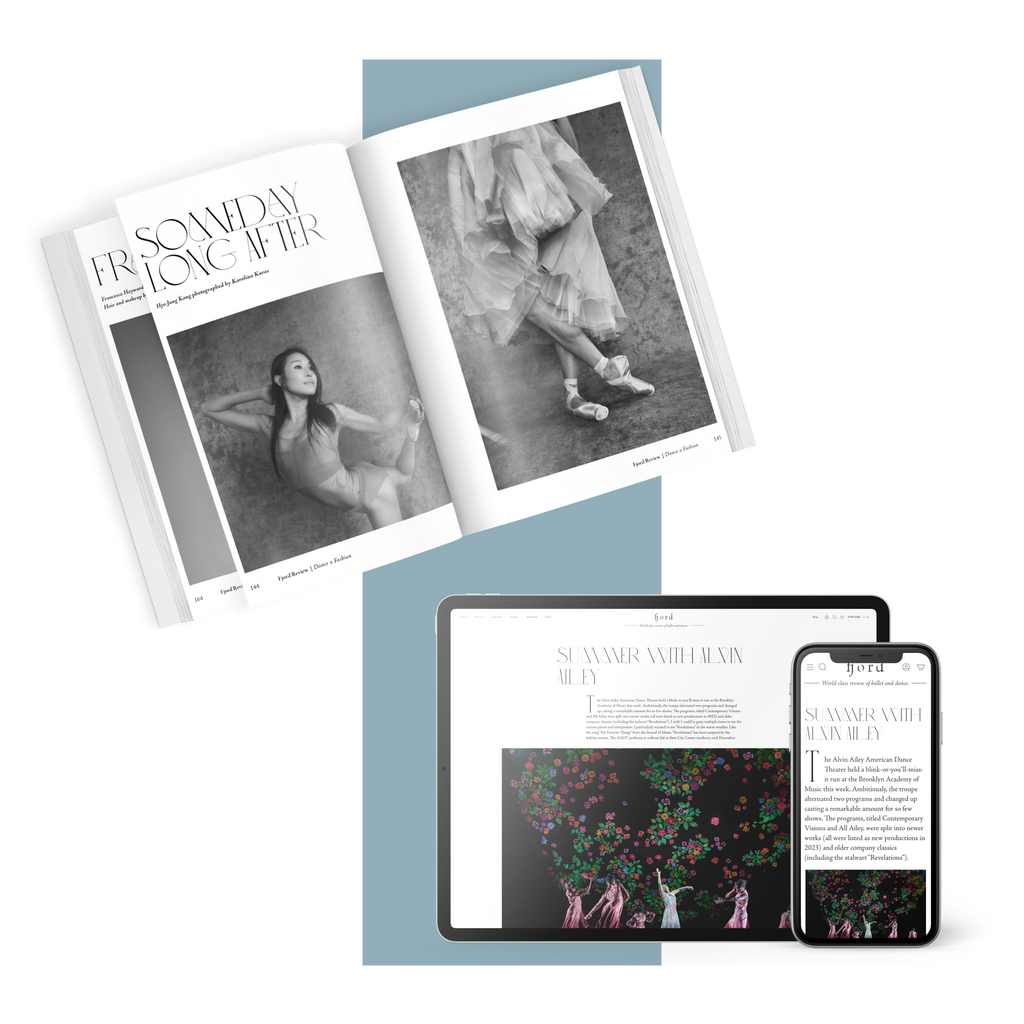
“Uncommonly intelligent, substantial coverage.”
Your weekly source for world-class dance reviews, interviews, articles, and more.
Already a paid subscriber? Login
As the Nor’easter wreaked havoc along the Mid-Atlantic seaboard, the wet winds calmed down enough by late Saturday afternoon to venture out to Alonzo King Lines Ballet that evening.
Continue Reading
“This resting, patience” has been danced in cities ranging from Helsinki to Porto to Venice, and in all of them the crooning vocals of its most-repeated music, Burt Bacharach’s “What the World Needs Now Is Love,” must have been instantly familiar.
Continue Reading
In the Chunky Move Studios, for Caroline Meaden’s “Immacolata,” presented as part of Melbourne Fringe Festival, two banks of seats, on the diagonal, hold a room.
Continue Reading
Upon arrival, two tall screens reveal a kaleidoscopic, fluid slither of serpents, as I find a seat in the downstairs Sylvia Staehli Theatre at Danceshouse, for Weichen Cui’s “In Green, In White—Metamorphosis of The White Snake,” presented as part of Melbourne Fringe Festival 2026.
Continue Reading
comments