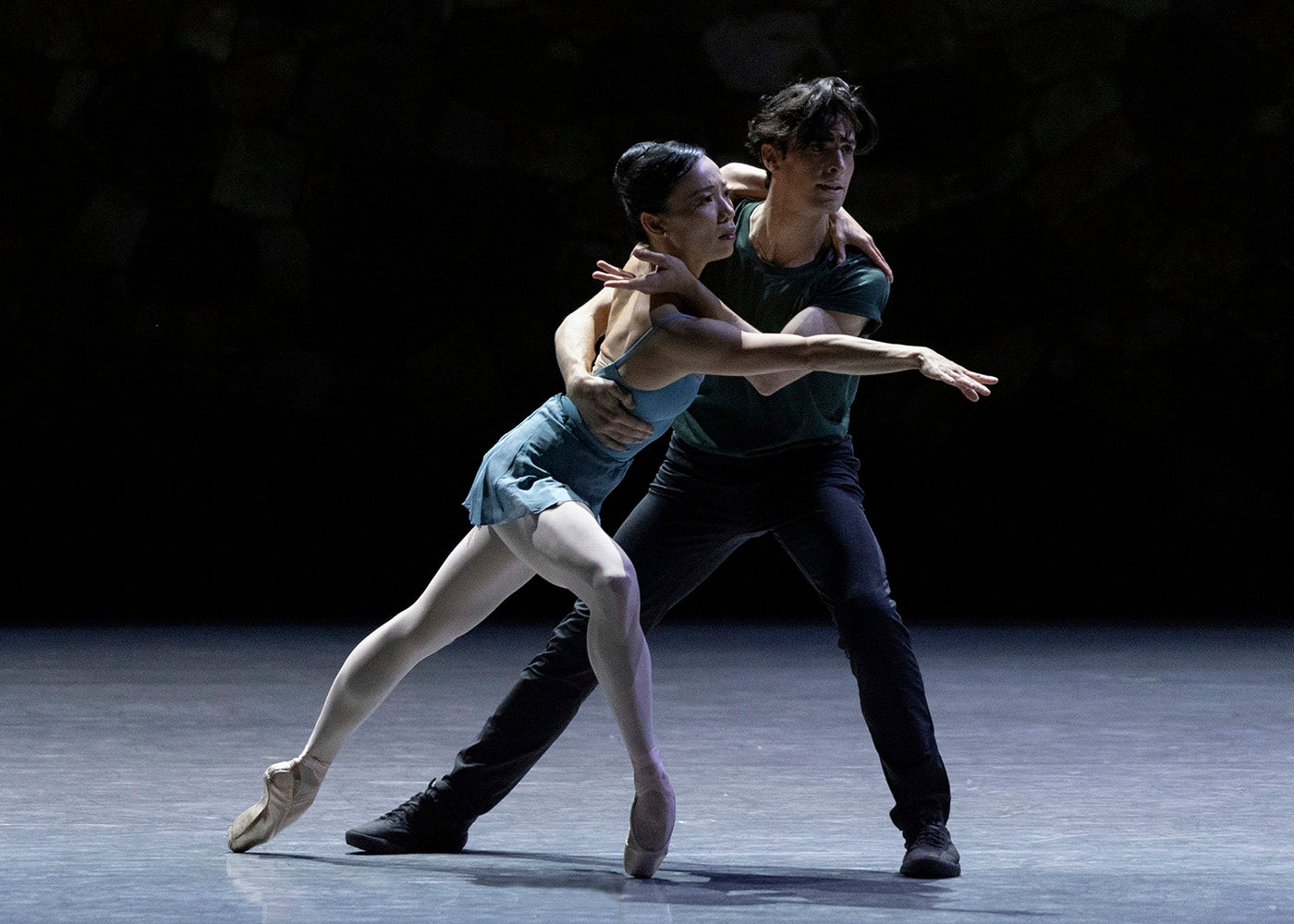
Fragile, delicate things must be handled with great care. So it is with choreographer/dancer Marc Brew's “MayBe,” conceived and directed by Natália Mallo in collaboration with him. It is a thing of profound beauty.
“Throwing his body up to a great height for a moment, he leans back, his legs extended, beats an entrechat-sept, and, slowly turning over onto his chest, arches his back and, lowering one leg, holds an arabesque in the air. Smoothly in this pure arabesque, he descends to the ground…. From the depths of the stage with a single leap, assemblé entrechat-dix, he flies towards the first wing.”[note]Bronislava Nijinska describing Vaslav Nijinsky’s Paris debut in Michel Fokine’s “Le Pavillon d’Armide,” from Bronislava Nijinska: Early Memoirs, trans. ed. Irina Nijinska and Jean Rawlinson (California: Holt, Rinehart and Winston, 1981), 270-271[/note] Vaslav Nijinsky...
Few personalities in the ballet world question the essence of classical dance nowadays. Masterpieces such as “The Nutcracker” or “Swan Lake” are little more than gainful blockbusters in December programs. “The Sleeping Beauty” is no exception: its seemingly Manichean argument, happy-ending, fairies' parade and decorative choreography had plunged the ballet into formaldehyde for centuries. So, when a modern-minded choreographer took on an age-old fairytale ballet, one could think that the outcome had to be of the cerebral type, for a few jaded balletomanes to enjoy. Fortunately, Ratmansky’s revival is anything but a pedantic throwback to the days of yore. He doesn’t lecture...
“The gods had condemned Sisyphus to ceaselessly rolling a rock to the top of a mountain, whence the stone would fall back of its own weight. They had thought with some reason that there is no more dreadful punishment than futile and hopeless labor.”[note]Albert Camus, The Myth of Sisyphus and Other Essays (New York: Vintage International, 1991), 119[/note] To me, this is what the creative process can feel like. Creativity is resilience and determination that comes to the fore when tested; when we “re-visit, re-spond and re-invent.”[note]Melanie Lane, Re-make artists statement, Next Move programme, Chunky Move, Melbourne, Victoria, September 2016[/note]...
In a programme by Alvin Ailey American Dance Theater you can almost guarantee a performance of formidable athleticism from a company of accomplished, rhythmical dancers. As the world famous company embark on a UK tour, their opening programme at Sadler's Wells, London, does not disappoint.
In Ernest Hemingway’s 1926 novel The Sun Also Rises, protagonist Jake Barnes describes the work of a veteran bull fighter. “It was not brilliant bull-fighting,” he says of a match. “It was only perfect bull-fighting.” Once, this competitor wowed crowds in the ring with daring tricks and unparalleled passion. In this late stage of his career, though, these same movements seem slick and staged. He wins his matches—but he does not win over his audience.
In an elegant tulle dress, she backs on stage, hunched and creeping. The articulate movements of her arms and upper body are filled with tension, the occasional convulsion resounding through her body. Upstage, under a cold spotlight, stands a lady clothed in a burnt orange gown, her gaze sad and distant. A man enters and dances between these two women. Against the steadily pulsating music the slow, drawn out movements of the trio have a sorrowful air. Each dancer appears absorbed in their individual world, yet there is a sense that these characters are intrinsically connected—a story waiting to unfold....
It's not often I feel left a little cold by beautiful male dancers moving in a space. But the first twenty minutes of Angelin Preljocaj's “MC 14/22 (Ceci est mon corps)” feels like a series of empty gesturesand takes a while to develop, presenting as it does a ritual cleansing to one side of the stage and to the other, dancers on trolleys, packaged and contorted like meat in containers. They seem to be merely posturing, and it's a little trite- bodies are ultimately meat: yes, we know. That's well-worn territory in dance.The whispering, too, is distracting. However, by the third scene,...
Les 7 Doigts de la Main (or “The 7 Fingers,” as it’s referred to by its English-speaking audiences) is frequently classified as a group of circus performers. Yet after watching one of the company’s elaborate productions, it becomes clear that this categorization is hardly enough to define it alone. The men and women onstage are circus performers, yes, but they are also dancers, actors, comedians, and—perhaps most surprising of all—they are people. People with stories and appetites.
Glitter—this was one of the first details I noticed when I arrived at Wilderness Festival last Friday. The shimmery stuff was everywhere, winking at me from eyelashes, cheeks, t-shirts, bunting. Poking out of pockets and tumbling out of tents, glinting and gleaming in the hot August sun. By the time I’d settled into the campsite, I’d come across a fair few sequins, rhinestones and feathers too.
As the audience files in to the genteel space of the Edinburgh Playhouse on this night, ominous bells chime—a portent of something truly disquieting. This sound acts as a warning that the show will not be an easy ride. What follows is breathtaking—and divisive. Vancouver's Holy Body Tattoo, along with enigmatic post-rock band from Montreal, Godspeed You! Black Emperor, are a deadly combination, an eerie evocation of the end of days. GY!BE have always had an epic, uncompromising ethos, so this is an exceptional and inspired pairing.
A very American Paris Opera season—the first programmed by the now-former director Benjamin Millepied—ended at Bastille the way it had started, i.e. with yet another American double bill, reuniting an eagerly-awaited creation by the so-called NYCB enfant prodige Justin Peck with a great classic by his major source of inspiration: George Balanchine. Two choreographers, one similar theme, some mixed results and an inevitable sense of fatigue, generated by a season overflowing with a limited choreographic set of possibilities that is typical of NYCB but not of Paris Opera Ballet.
Watching Matthew Bourne's reworked version of the “star-cross'd lovers,” I was briefly reminded of Veronica, played by Winona Ryder, in the dark 1988 comedy by Daniel Waters and Michael Lehmann, Heathers, and her line, “my teen angst bullshit has a body count.” Yes, this is the darker side of Bourne's repertoire,...
Beneath blue California skies, manicured trees, and the occasional hum of an overhead airplane, Tamara Rojo took the Frost Amphitheater stage at Stanford University to introduce herself as the new artistic director of San Francisco Ballet.
After a week of the well-balanced meal that is “Jewels”—the nutritive, potentially tedious, leafy greens of “Emeralds,” the gamy, carnivorous “Rubies,” and the decadent, shiny white mountains of meringue in “Diamonds”—the New York City Ballet continued its 75th Anniversary All-Balanchine Fall Season with rather more dyspeptic fare.