This site has limited support for your browser. We recommend switching to Edge, Chrome, Safari, or Firefox.

Detail Oriented

As a dance viewer, it’s easy to get swept up in the grand movements in a piece, glossing over the finer details. But when a piece leans into the minutiae, using small movements and motifs to drive home a central theme, it’s usually quite memorable. Ririe-Woodbury Dance Company’s 60th anniversary season closer, “Ascent,” was full of glorious details.

Performance

Ririe-Woodbury Dance Company’s “Ascent:” Charlotte Boye-Christensen’s “Chapters of Being,” Stefanie Batten Bland’s “Look Who’s Coming to Dinner,” and Daniel Charon’s “Storyograph

Place

 Leona Wagner Black Box Theater at the Rose Wagner Performing Arts Center, Salt Lake City, UT, April 18, 2024

Words

Sophie Bress

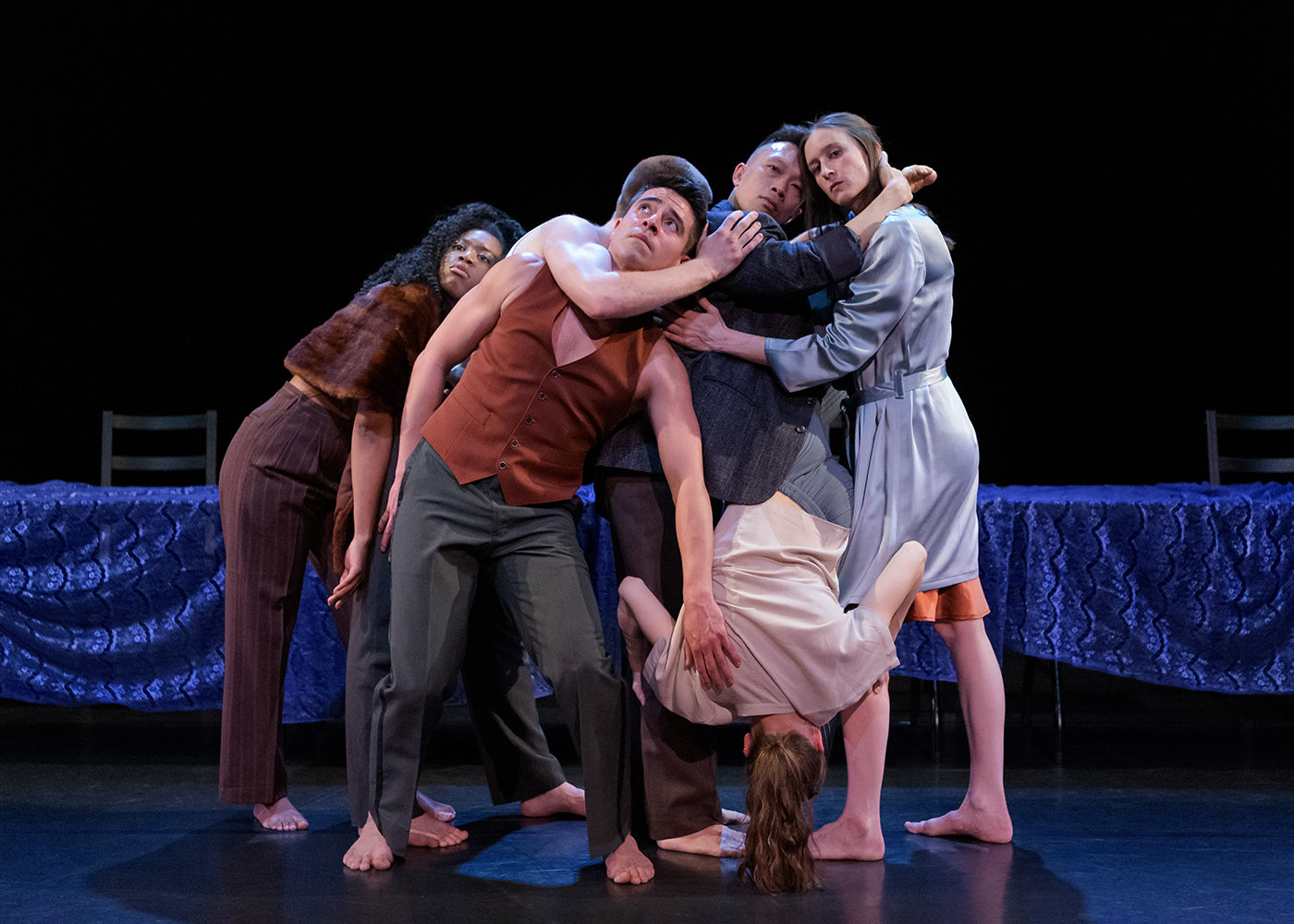
Ririe-Woodbury Dance Company in Stefanie Batten Bland’s “Look Who’s Coming to Dinner.” Photograph by Stuart Ruckman

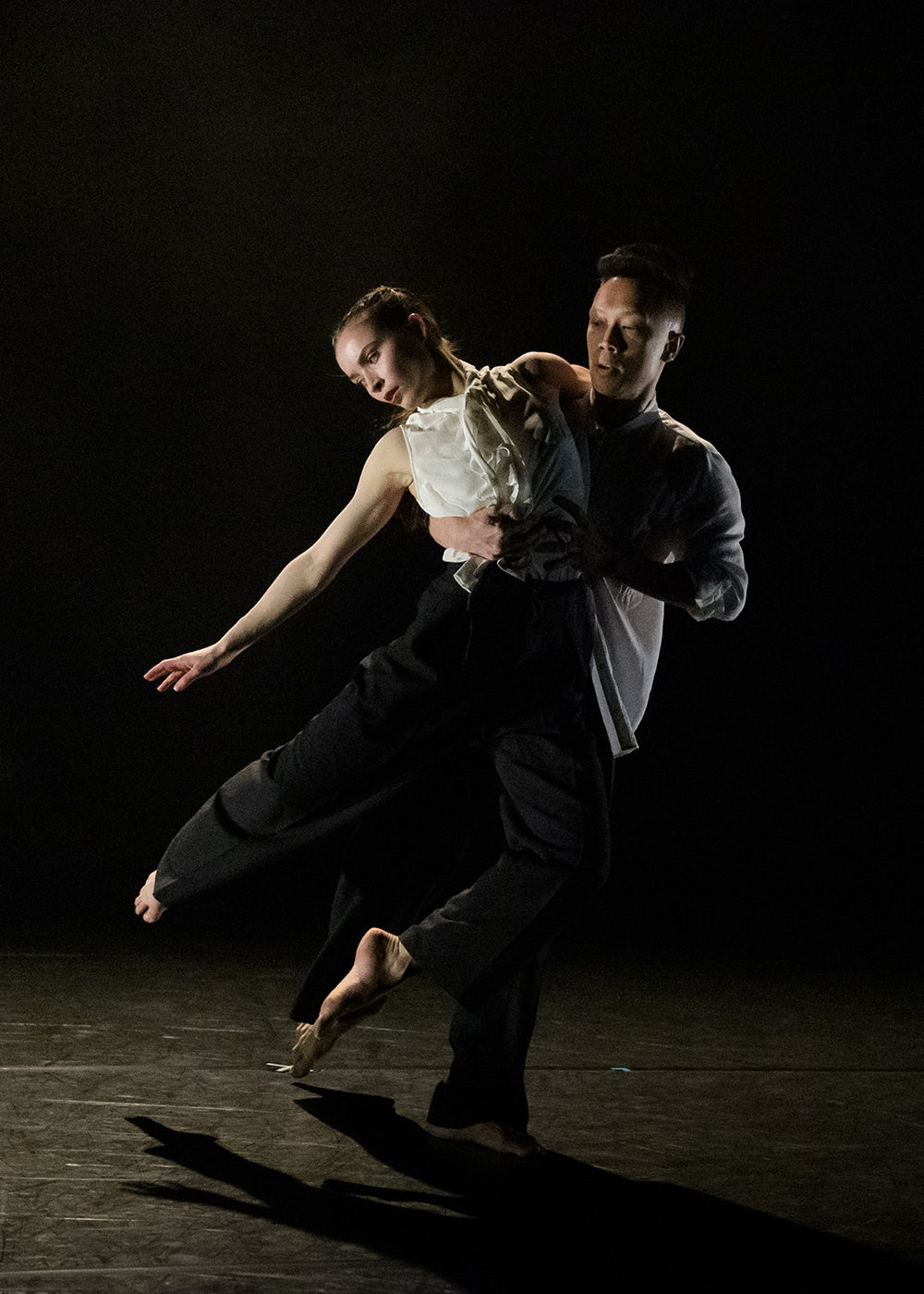
The evening began with the world premiere of Charlotte Boye-Christensen’s “Chapters of Being,” which explored themes of connection and disconnection. These centralities were enhanced by the dancer’s expert use of gaze as a tool to relate with and distance themselves from one another. 

Throughout the first portion of the piece, the dancer’s movements were almost nondescript in their loveliness—it was a contemporary work like any other. Then, the lighting and music changed in intensity and the dancers began to look at—and seemingly truly see—one another. Through this, their movement became raw and human.

The work vacillated between these extremes, resulting in a feeling of searching and yearning. In one section, the entire cast performed in unison while looking down—there was no connection between them aside from the identical exactness of the choreography. In a duet for Alexander Pham and Sasha Rydlizky, the dancers are back to back, spinning around each other—they are touching, yet still looking for one another in vain.

“Chapters of Being” was dedicated to the late Joan Woodbury, who founded the company in 1964 along with Shirley Ririe and passed away in November 2023, and Utah-based dancer Stefanie Slade, who passed away in 2020. Because of this, a feeling of grief was palpable as the dancers connected and disconnected from one another, never giving up the search.

Ririe-Woodbury Dance Company in Charlotte Boye-Christensen’s “Chapters of Being.” Photograph by Stuart Ruckman

Ririe-Woodbury Dance Company in Charlotte Boye-Christensen’s “Chapters of Being.” Photograph by Stuart Ruckman

The evening continued with Stefanie Batten Bland’s 2019 “Look Who’s Coming to Dinner,” a work also enhanced by a heavy dose of detail and gesture. The piece begins with the dancers, clad in dress clothes and surgical masks, slowly entering the stage, staring into the audience’s eyes with eerie accuracy. As the piece progresses and the dancers gather around a long dinner table, this gaze becomes central, switching between cold, foreboding stares (sometimes accompanied by a forced baring of the teeth) and genuine, welcoming smiles.

Although the masks (removed shortly after the dancer’s entrances), were a literal part of the costumes, they also represented the theme of the work—how the masks we put on affect ours and others ability to get a seat at the proverbial table. The work also involved several literal tables, adorned with purple lace tablecloths that doubled as veils for the dancers in specific moments. Along with the directness of the set and costumes, the use of detail—smiles melting into frowns, lots of handshakes, and the use of gaze, both empty and full of life—drove home this theme. So too did the dance-y sections, solos for each performer that gave insight into their character and the ways their life experiences affected how they showed up to dinner.

Towards the tail end of the work, the tables were stood on end and turned into doors. The dancers began to knock and bang on these doors, still asking for a spot at the table. The work ends with the dancers banging on the fourth wall, asking the audience to open up. When we do, we’re met with a humble handshake and an unembellished “hi.”


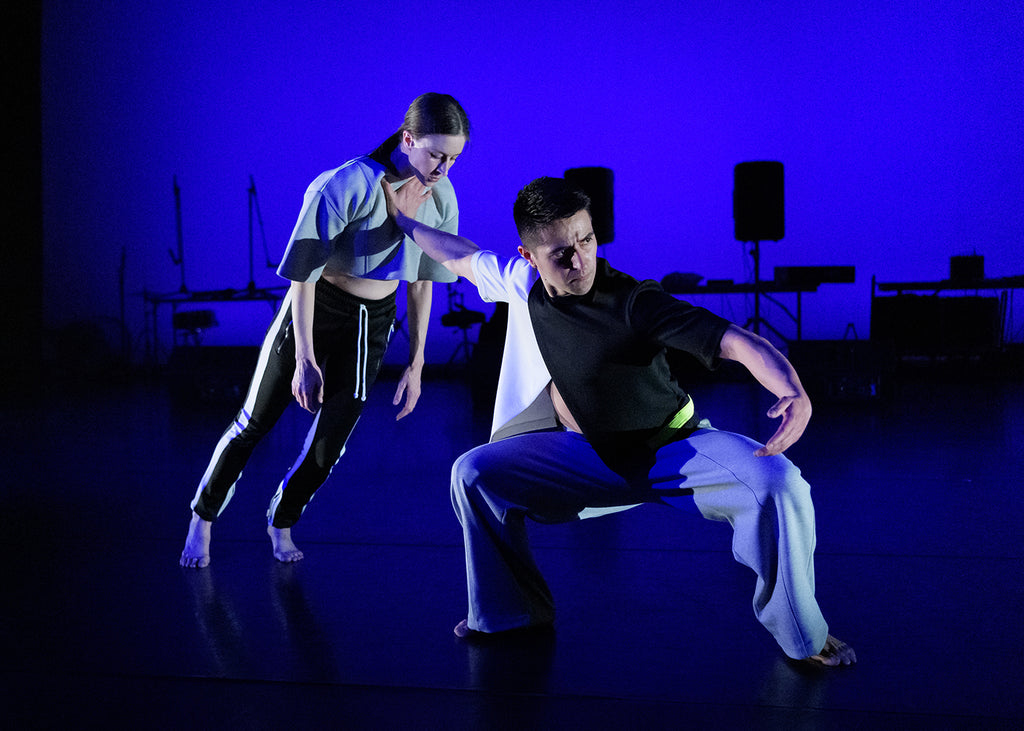
Ririe-Woodbury Dance Company in Daniel Charon’s “Storyograph.” Photograph by Stuart Ruckman

Ririe-Woodbury Dance Company in Daniel Charon’s “Storyograph.” Photograph by Stuart Ruckman

“Look Who’s Coming to Dinner” was followed by the world premiere of Ririe-Woodbury artistic director Daniel Charon’s “Storyograph,” a melodic and musically driven collaboration with the Salt Lake Electric Ensemble. In this piece, the details came from the music, which profoundly affected both the choreography and the dancer’s approach to it. When the music shifted, so did the dancers. When it veered off into different territory, the dancers also charted new ground. A small blip could introduce a micromovement, and a larger change could introduce an entirely new feeling.

The work had a distinctly futuristic bent, especially driven home by the musicians, who performed—using a mixture of guitars, keyboards, mixers, faders, and MacBooks—onstage along with the dancers. In one section, the dancers gave the stage to the musicians entirely, offering the audience a chance to observe the tiny movements—the pluck of a string, adjustment of a dial, or press of a button—that contributed to the vivid soundscape we were experiencing.

Sophie Bress


Sophie Bress is an arts and culture journalist and dance critic. She regularly contributes to Dance Magazine and Fjord Review, and has also written for The New York Times, NPR, Observer, Pointe, and more. 

subscribe to the latest in dance


“Uncommonly intelligent, substantial coverage.”

Your weekly source for world-class dance reviews, interviews, articles, and more.

Already a paid subscriber? Login

comments

Please note, comments must be approved before they are published

Featured

Five Remembrances of a Benefactor
Obituaries | Rachel Howard

Five Remembrances of a Benefactor

The way Margaret Jenkins tells it, Dianne came to her dance company’s studios in 1973, asking to take class. Dianne was then living in a one-bedroom apartment near San Francisco’s Mission District with her scientist husband and three young kids.

FREE ARTICLE
Oceans Apart
REVIEWS | Kris Kosaka

Oceans Apart

Waiting in the theater, the first unhurried trickle of French composer Erik Satie’s piano variation barely registers amidst the house chatter. Sparse and minimalistic, swelling with silences, the striking keys eventually conjure up a dancer.

Continue Reading
Timeless Terrain
REVIEWS | Elsa Giovanna Simonetti

Timeless Terrain

“When you visit Kati Thanda–Lake Eyre, you realise that this is a place where time does not exist,” writes choreographer Frances Rings in her notes for Terrain, and the resonance with Wayne McGregor’s theme for the 2026 Biennale Danza, Time Does Not Exist, is unmistakable.

Continue Reading
All About Love
REVIEWS | Rebecca Deczynski

All About Love

It starts out light and coquettish. George Balanchine’s “Sonatine,” set to the composition by Maurice Ravel of the same name, is undeniably lighthearted, as the dancers—here, Léonore Baulac and Germain Louvet—find themselves animated by the music, as they share the stage with a grand piano (and pianist Elena Bonnay at its helm).

Continue Reading
Good Subscription Agency