Founded in 2004 by dancer Tiago Sousa and Destri, the troupe, whose members come from the favelas (slums), of a racially and economically divided Rio de Janeiro, had a mission: to wed the three roots of Brazilian culture—indigenous, European and African—with contemporary dance. This sounds easy enough—and not exactly novel (hello, fusion!)—but in Destri’s deft hands, the work has a polish and style that stems from her own background as a dancer, having trained with such luminaries as Pina Bausch, Alwin Nikolais and Twyla Tharp.
Oh—and did we say that Destri, who also works in film and television, is a middle class white girl in the company that consists of mostly men of African descent? Hah: Tapping into her inner gangsta, Destri seems to have struck a chord with global audiences (this reviewer first saw the troupe at the Biennale de Lyon, in 2006), and, in its Los Angeles debut, the sold-out crowd also jumped on board the Brazilian dance wagon—in this case, two works—with an unmitigated passion.
In “ID: Entidades,” initially created in 2009 for eight men, the signature piece now features a septet of dudes and the troupe’s sole female, Jessica Nascimento (no “Girl From Ipanema” she), who decidedly held her own while also adding an element of mystery—and sex appeal, the latter in the evening’s closing work.
Set to Rodrigo Marçal’s evocative minimalist score of keyboards, electronica, looping guitar (the Brazilian instrument known as a “violão”) and notable stretches of silence, the 45-minute “ID” was moody, confrontational and muscular, at the same time, putting the ‘hip’ back into hip-hop.
Seriously, with an element of violence bubbling beneath the glossy surface of these toned and hyperactive bodies (a reflection, no doubt, of the hardscrabble Brazilian street life they knew/know so well), the work opened in near darkness (lighting design by Renato Machado), with a sinewy André Feijão giving us his best shoulder isolations, a swoon-worthy vocabulary that also extended to his arms, Plisetskaya-like, in their fluttery execution.
Dancers then took turns stealthing onto the stage, moving in and out of Machado’s spotlight with articulated fluidity. Punctuated with solos, duets and trios, as well as fierce unisons, the work featured the performers in a kind of rhythmic revolt, their undulations, jumps and b-boy spinnings a marvel to behold, minus, however, the underlying threats of competition and one-upmanship, hallmarks of the street.
These are, instead, stories writ large on the performers’ bodies—extreme backbends, yoga-type elongations, arabesqued headstands (try and imagine this), and lyrical somersaults (oxymoronic as those may sound), that also gave way to corporeal eruptions and explosions: dancers as human TNT.
Tenderness coursed through the work, as well, where couplings amplified hope through the simple act of putting hand to shoulder. The dancers also circled, a bipedal carousel, creating visceral patterns, when they weren’t observing each other’s terpsichorean confessions from seated positions on the floor. Twists, barrel turns and one-armed cartwheels gave way to a brief, but intense running motif as the work, far from the bling-encrusted Rio we know from Carnival imagery, came to an indelible close.
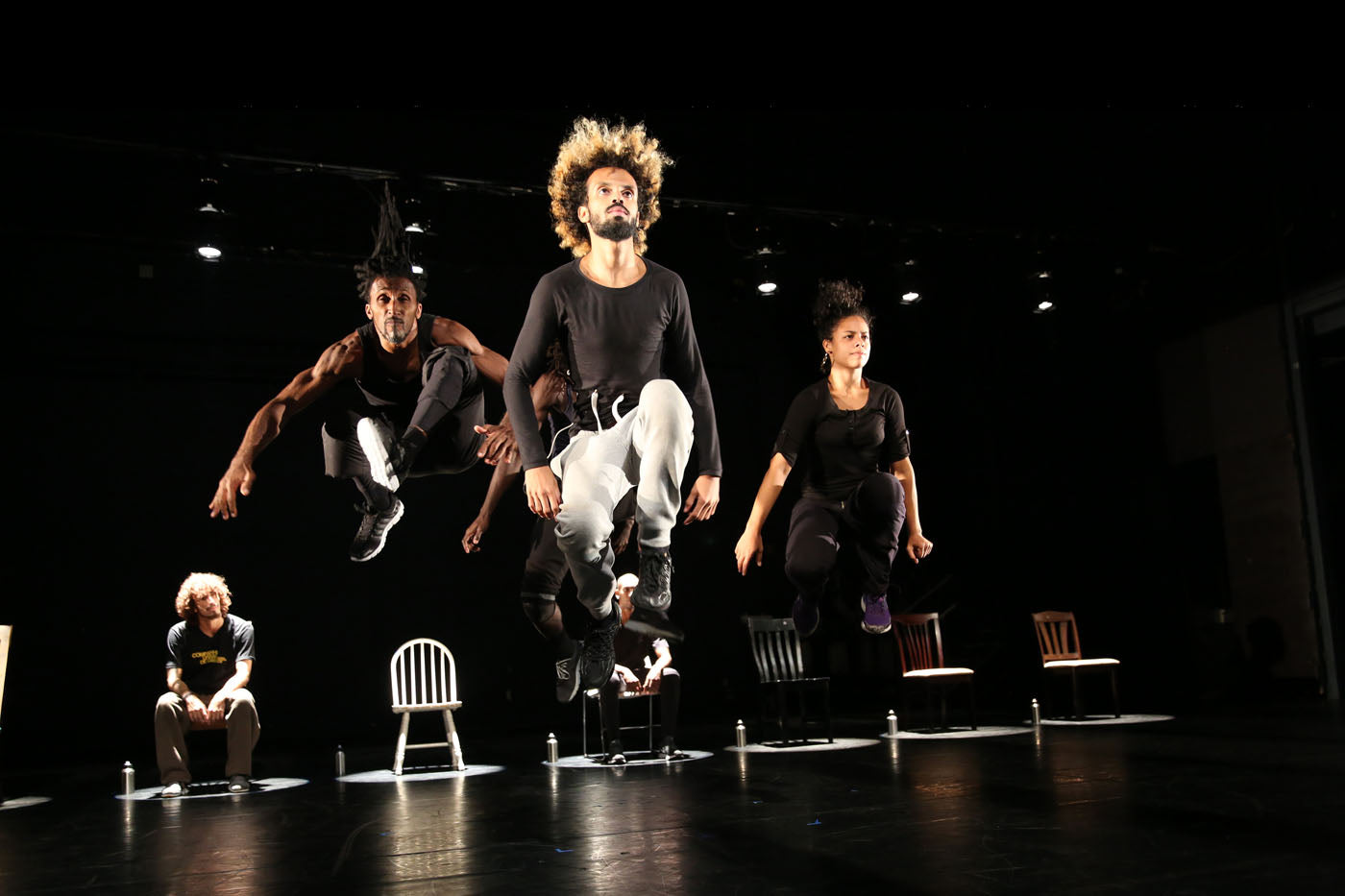
In contrast to “ID,” the 2012 work, “Na Pista” (literally, ‘on the dance floor’), is a party, a celebration, a disco-themed romp, featuring an overhead requisite silver-mirrored ball, with dancers decked out in shindig finery (costumes credited to Urban “Carioca” Outfit). Also set to a Marçal score, this a buoyant one sampled with recognizable riffs, including snippets of Bowie and Amy Winehouse, the work, overly long, though, at 45 minutes, featured the use of chairs, props that are ubiquitous in modern dance and can sometimes feel clichéd.
But whether a nod to Anne Teresa De Keersmaeker’s “Rosas danst Rosas,” or Liza Minnelli flaunting her stuff in “Mein Herr” from Bob Fosse’s Cabaret, the chairs served as a launching pad for dancers, including Julio Rocha, Miguel Fernandes and Nascimento, whose meteoric and gritty jumps enthralled. In addition, the dancers played a game of musical chairs, a festive piece of frippery, for sure.
There was also slo-mo walking, chatting amongst themselves in Portuguese, unison sipping from water bottles and all sorts of choreographic snippets on view—from capoeira and line dances to samba, vogueing and dollops of Michael Jackson. And, lest we forget, there was booty shaking galore, a short French narrative voice-over and John Travolta-inspired moves, both from Saturday Night Fever and Pulp Fiction.
Having gotten the party started, as well as keeping it akin to Tesla’s “Insane Mode” (zooming from 0 to 70 in less than three seconds), the determined dancers, including Johnny Britto, Allan Wagner, Thiago Williams and crew, blasted through an encore that took them through a series of frenetic solos, as well as a jaunt up the aisles of REDCAT, the place to be for all things cool.





comments