This site has limited support for your browser. We recommend switching to Edge, Chrome, Safari, or Firefox.

Body of Work

A shape-shifter nonpareil, the single-named performer, Oguri, never fails to flabbergast, bemuse and inspire awe in mere mortals who have been making up his Southern California audiences for some thirty-three years. His latest piece, “dance comes out of time,” a 45-minute solo performed to the live, albeit offstage, music of Paul Chavez, himself a three-decade collaborator with the dancer, was presented at the Electric Lodge last weekend as part of the ongoing series, “Flower of the Season.”  

Performance

Oguri: “dance comes out of time”

Place

The Electric Lodge, Venice, California, June 16-18, 2023

Words

Victoria Looseleaf

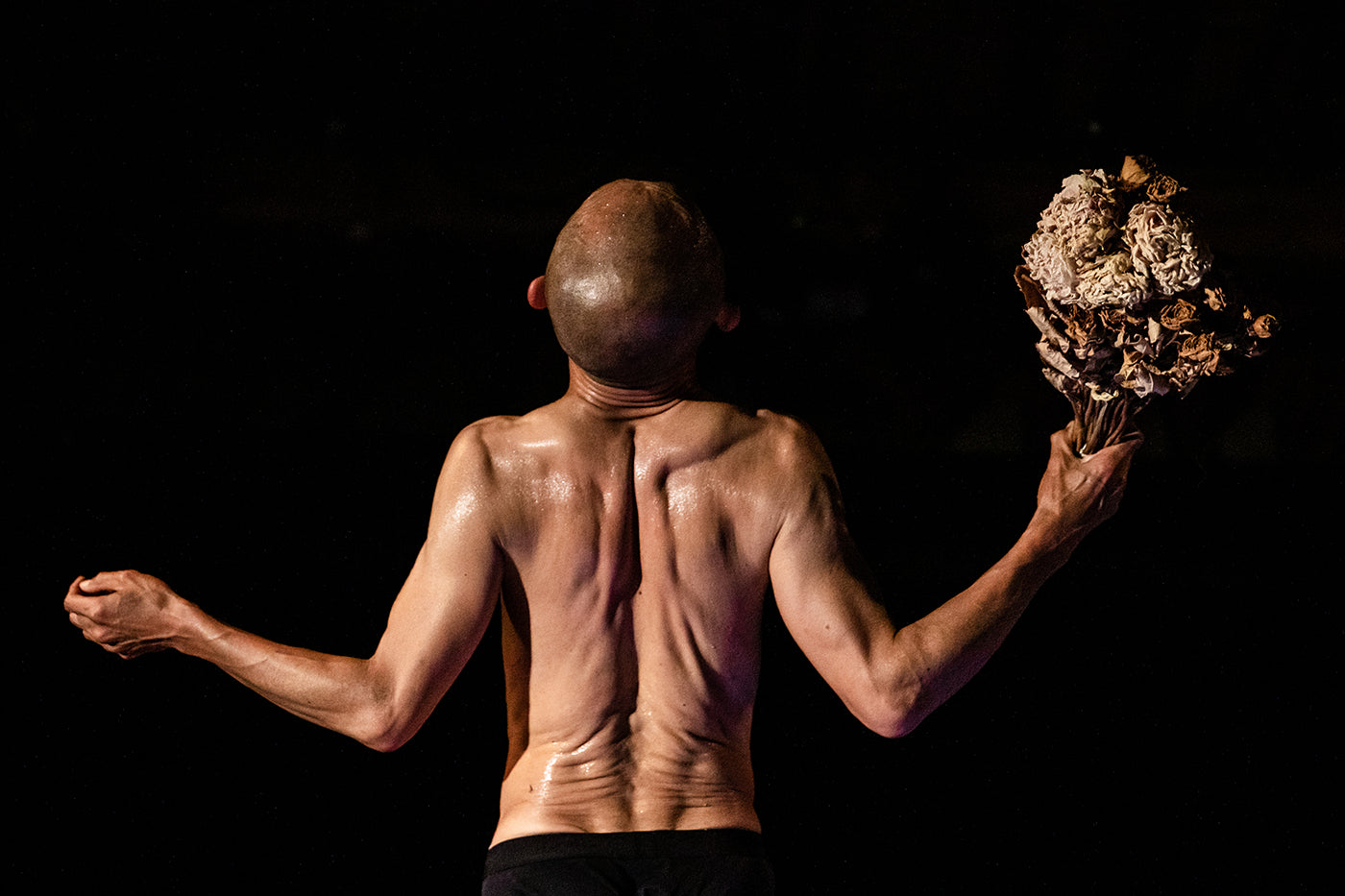
Oguri's “dance comes out of time.” Photograph by Denise Leitner 

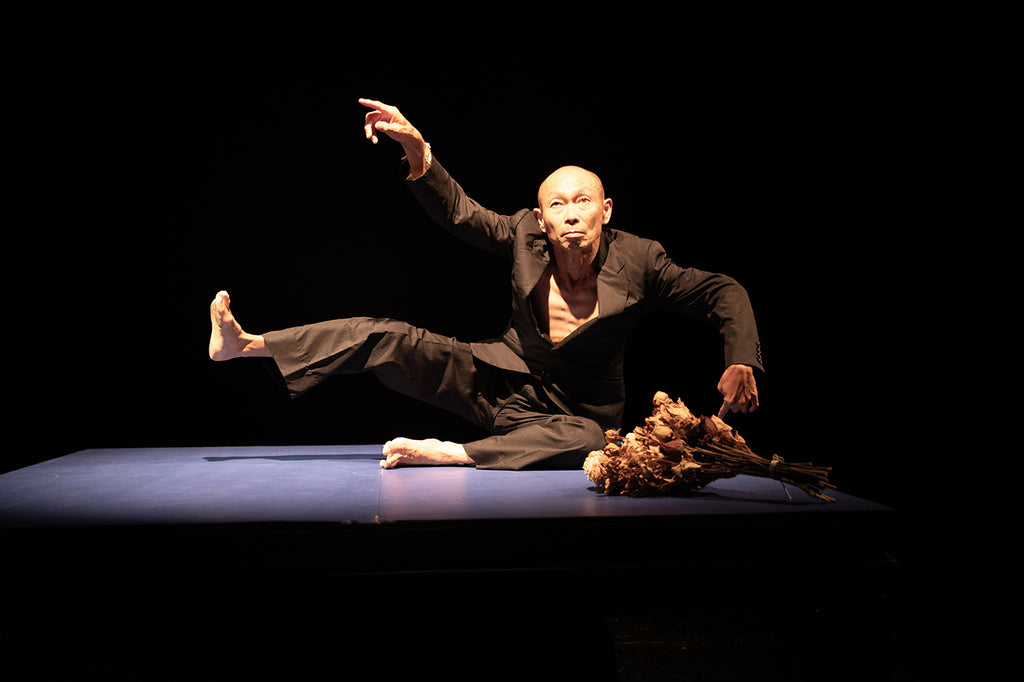
Now in its twentieth iteration, the series, produced by Oguri and his wife Roxanne Steinberg, is a byproduct of Body Weather Laboratory, workshops that further alliances among dancers, musicians, artists and writers. And, to emphasize the floral aspect of the series—but probably not—here was Oguri inching oh-so-slowly onto the black box space, wielding a bouquet of dried flowers and clad in a tailored brown Giacomo Trabalza suit—as if he were a Japanese salaryman about to begin his workday. 

But this is no routine office! Indeed, with the suit-clad performer both bare-chested and bare-footed, his beatific gaze a study in concentration, and the amber lighting (designed by father and son, Oguri and Keiden Oguri), creating a kind of phosphorescent glow, this worker/cum/Buddha makes the drudgery of what might be another ho-hum day in the life of everyman, a trek, instead, into a transcendental realm, his splayed fingers and arched feet all part of the artistic package.

Oguri's “dance comes out of time.” Photograph by Denise Leitner 

Oguri's “dance comes out of time.” Photograph by Denise Leitner 

Until, that is, the dancer begins slapping himself on the face, finally dropping to one knee before beginning a pas de deux, yes, with those very dead roses, only to rise up and hug the wall, as though manipulated by some kind of puppet master in the sky, accompanied here by Chavez’ tiny, bell-like sounds. 

Chavez, who, according to the program notes, “explores sonic textures and space created through the digital manipulation of found sounds and homemade instruments,” was not quiet for long, as the stealth-stud Oguri, if only for a moment, an instant, was then submerged in a blackness where he alone could be seen moving towards a graded platform (a draftsman’s desk, a backless park bench, a picnic table?). 

Mounting the prop (set design also by father and son)—and decidedly not waiting for Godot, or anyone, for that matter—Oguri began a sequence of contortions with such ease, such fluidity, that it was not a sleight-of-hand motion, but an offering to the world, that was, well, a sleight-of body bearing: kneeling, with one arm raised, eyes intently gazing up; balancing on one leg, the other aloft, those flowers never far from view; propped on one elbow, a wisp of a smile on his face; sitting, but leaning backwards.

The near-impossible control he has over his being, does, actually seem to stop time.

Oguri's “dance comes out of time.” Photograph by Denise Leitner 

Oguri's “dance comes out of time.” Photograph by Denise Leitner 

Time: Oguri is slicing through it; where he has been blurs into where he is, this chameleon-esque creature one wishes to—negative, one must—know, in order to grasp where he might be going next. Decidedly, this insanely gorgeous sleight-of-body feat was on full display when the mover disappeared under the platform. A journey of only a few feet, this felt like a lifetime, as we, a spellbound audience, awaited his return.

And what a return it was: Emerging, as if a spectacular butterfly from a cocoon, this brilliant being, naked save for a flesh-colored thong—think Superman, but in reverse, his secret weapon not a cape and tights, but his skin, glistening, his sinewed back, otherworldly, his limbs a guidepost to knowledge, both arcane and revealing—continued his dance of destiny, a mazurka of majesty, a peerless, if you will, pavane. 

While this writer suspected that Oguri would disrobe—as is his wont—or de-suit, as it were, it remained a shock to the senses to witness his ageless body assaying concentrated and deliberate moves wherein he would be rooted to the ground one moment—with gongs thrumming in the distance, the percussion, in accelerando mode, coursing through the theater—followed by stasis, his veins proving to be a map, yes, to nothing less than existence. 

But what’s a guidebook to reality without a soupçon of humor? In the world of Oguri, it means deploying tiny bourrées before morphing into a scarecrow-ish, rubbery-limbed mass of perfect matter. Accompanied by a train-like whistle and a descending woodwind soundscape, the dancer skittered into what can only be deemed a hip-hop pattern, his silent scream piercing the air.

Oguri's “dance comes out of time.” Photograph by Denise Leitner 

Oguri's “dance comes out of time.” Photograph by Denise Leitner 

Like Kafka’s Gregor Samsa in Metamorphosis, Oguri transforms and transmutes, also rubbing, in the process, once or twice, his shiny bald head. But he never transgresses, at least not in any moral sense, though pushing boundaries, yes, that he does, simultaneously swimming in an ocean of theatrical air, light and sound, a knowing half-smile inviting acolytes into his realm, if only vicariously. Appearing at times to bear, like Atlas, the weight of the world on his exquisite shoulders, we want to know what he knows, feel what he feels, move like he moves.

Then into the abyss he goes. For now, at least, only to return in yet another Giacomo Trabalza suit, this a muted grayish silver—but worn inside-out! Could there be anything more perfect. 

In a word, “yes.”

Because the dance continued. Here was Oguri, spinning like a Sufi, running in a small, tight circle, crouching and rising, his body not only a temple, but a magnificent cathedral. But wait: Is it possible that there are tears in his eyes. Has time stopped? Is it moving forward? Where does it end? Where did it begin? 

Or, as Paul Bowles wrote in The Sheltering Sky, which Oguri cited in the program notes: “How many more times will you watch the full moon rise? Perhaps twenty. And yet it all seems limitless.”

Unanswerable questions, for sure, but ones leaving this reviewer grateful that Oguri does what he does, slowing down time while shutting down the outside world, giving meaning to the indecipherable. 

In other words: It’s glorious to be alive.

Victoria Looseleaf


Victoria Looseleaf is an award-winning, Los Angeles-based international arts journalist who covers music and dance festivals around the world. Among the many publications she has contributed to are the Los Angeles Times, the New York Times, Dance Magazine and KCET’s Artbound. In addition, she taught dance history at USC and Santa Monica College. Looseleaf’s novella-in-verse, Isn't It Rich? is available from Amazon, and and her latest book, Russ & Iggy’s Art Alphabet with illustrations by JT Steiny, was recently published by Red Sky Presents. Looseleaf can be reached through Twitter, Facebook, Instagram and Linked In, as well as at her online arts magazine ArtNowLA.

subscribe to the latest in dance


“Uncommonly intelligent, substantial coverage.”

Your weekly source for world-class dance reviews, interviews, articles, and more.

Already a paid subscriber? Login

comments

Please note, comments must be approved before they are published

Featured

Positive Masculinity
REVIEWS | Lorna Irvine

Positive Masculinity

At a time when the roots of toxic masculinity are still being hotly debated within society (I'd argue nature and nurture aren't necessarily mutually exclusive bedfellows) the excellent “Boys Don't Dance” arrives, fully formed  at a festival for children, but with enough layers to appease any audience.

Continue Reading
We're all Mad Here
REVIEWS | Valentina Bonelli

We're all Mad Here

Just as The Wizard of Oz to the United States or Pinocchio to Italy, Alice’s Adventures in Wonderland is the coming-of-age novel of English childhood. The reception of Christopher Wheeldon’s ballet of the same name depends heavily on this legacy.

Continue Reading
Dancing for Chagall
REVIEWS | Kris Kosaka

Dancing for Chagall

Director and choreographer Naoya Homan’s reimagining of “Aleko,” a one-act ballet where art takes center stage, dazzles the eye with a tragic meditation on the limits of freedom.

Continue Reading
A Moving Museum 
REVIEWS | Greta Pieropan

A Moving Museum 

In “Me Time—Danza al Museo” by choreographer Camilla Monga, dance becomes a tool for deeper seeing. Through choreography, the museum becomes a space of cognitive and emotional activation. The result is an encounter that lingers long after the performance ends.  

Continue Reading
Good Subscription Agency