Michael Keegan-Dolan’s first production with his company Teaċ Daṁsa was a version of “Swan Lake” reworked into a critique of the Catholic church. With “MÁM,” the Irish dancemaker continues to probe the keystones of Irish culture, this time with a more impressionistic lens. The new work glides through a fog of cigarettes and dance halls, intimacy and anguish, craggy sea cliffs and whispers of holy ghosts. Its scope is cosmic and targeted at once, hitching the profundities of existence to the minutiae of everyday life. Mám means ‘mountain pass,’ but it can also refer to an obligation or a handful of treats. The ambiguity sits well with this wild-eyed piece of dance theatre.
Link copied to clipboard
Performance
Teaċ Daṁsa: “MÁM”
Place
Sadler's Wells, London, UK, February 5, 2020
Words
Sara Veale
Teaċ Daṁsa in Michael Keegan-Dolan's “MÁM.” Photograph by Ros Kavanagh
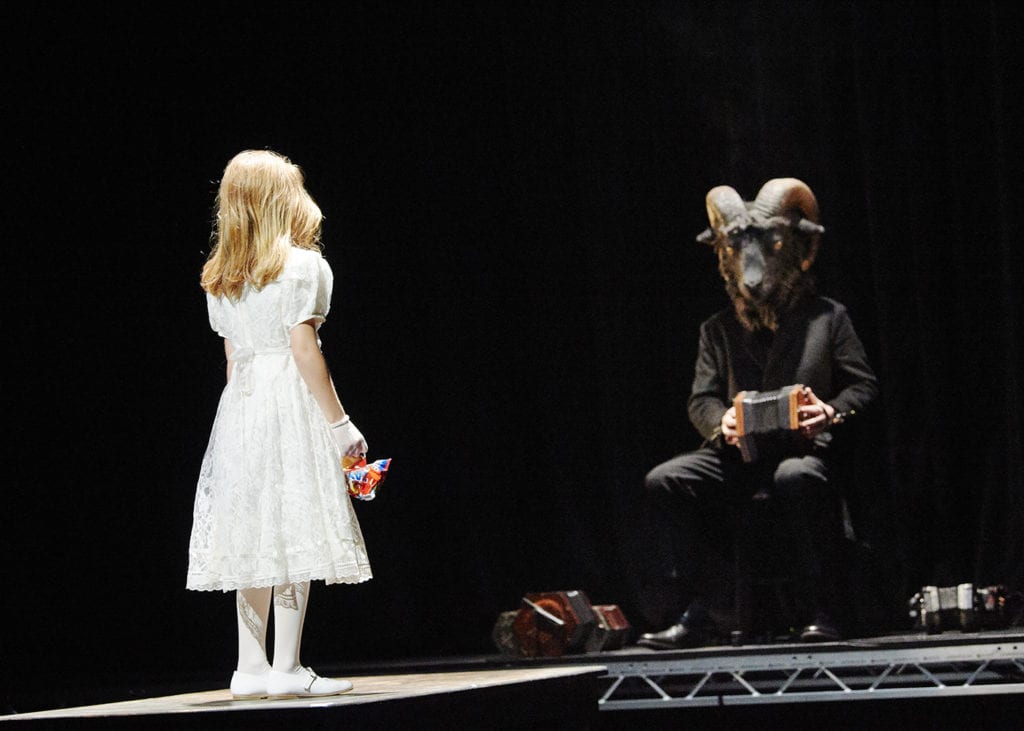
We begin with a fairy-tale scene (Grimm not
Disney): a young girl munches on potato chips while a ram-headed beast reels
behind her. The head comes off, revealing concertina player Cormac Begley
underneath, and a curtain’s ripped away to introduce a dozen dancers in
balaclavas, snapping and stomping to Begley’s huffing exhalations. It’s the
start of a series of layers pulled back, each one unveiling new emotions channelled
through the thunderous music of the body.
Keegan-Dolan built the piece around—and in—a community hall in the foothills of Cnoc Bréanainn, Ireland’s second-highest mountain. The set sports the hallmarks of provincial function rooms world-round: wooden chairs and heavy curtains, makeshift stages and humble formalwear. There’s a timelessness to this milieu, the costuming in particular, with the women in long black dresses, the men in ankle-bearing suits. The young girl—the choreographer’s eight-year-old daughter—wears an immaculate white dress that’s equal parts first communion and Alice in Wonderland. It could be 1950 or 2020; tradition and modernity shed their contours in this shadowy space.
Teaċ Daṁsa in Michael Keegan-Dolan's “MÁM.” Photograph by Ros Kavanagh
Moods also collapse into each other. The dramaturgy
presents an eloquent tangle of rage, bliss and mania. We see a couple stagger
across their castmates’ laps only to crumple once they connect. Elsewhere there’s
laughter that turns to tears, and brawls that end in mirth. These emotional fever
pitches bring notes of clarity to the work’s sporadic political references, including
its gestures at alcoholism and same-sex relationships.
The choreography has extremes of its own:
sharp, huffing bops, punch-drunk waltzes, aggressive club moves peppered with
high kicks and jerky stomps. Even the slower sequences weigh heavily, thickening
Begley’s musical stylings, which swerve from celebratory to hymnal to funereal.
In one skittering jig, smoke spurts from his seat as the beat intensifies.
Another curtain comes down, and an entire band (contemporary orchestra
stargaze) steps in to add fuel to the fire.
The Teaċ Daṁsa collective includes some pretty young things—including Imogen Alvares, formerly of Rambert2, and BBC Young Dancer winner Connor Scott—alongside decorated performers like Rachel Poirer, Keegan-Dolan’s formidably elegant wife. James Southward is scruffy and magnetic here, utterly lost in the moment as he kisses his friends in the giddy twilight hours of a party. Carys Staton is likewise passionate; her scooping, crouching solo is channelled so intensely you wonder whether it’ll be her making or her undoing.
There are hints of Pina Bausch in the eccentricity of it all—the cigarettes smoked and snacks crunched, the japes and jives and wistful currents of memory. The group brings glamour to bumping hips and goofy poses, humour and beauty too. However abstract they get, their antics are too deeply felt to be pretentious. It’s what we yearn for dance to be: sincere, vulnerable and engaged.
Sara Veale
Sara Veale is a London-based writer and editor. She's written about dance for the Observer, the Spectator, DanceTabs, Auditorium Magazine, Exeunt and more. Her first book, Untamed: The Radical Women of Modern Dance, will be published in 2024.
subscribe to the latest in dance
“Uncommonly intelligent, substantial coverage.”
Your weekly source for world-class dance reviews, interviews, articles, and more.
In approaching a New York City Ballet Fall Fashion Gala commission, choreographers have two choices: make a dance that hinges upon the fashion, or make a dance regardless of the fashion, and hope that the costumes enhance rather than detract from the steps.
Things seem to be clicking in place for Mamela Nyamza. Her latest work “The Herd/Less” is touring the world while her recognition as a choreographer with a distinction for the subversive and political has earned her a Silver Lion for dance at the Venice Biennale.
After taking a field trip in the second grade to see the Alvin Ailey American Dance Theater, Ronald K. Brown was inspired to take his first dance class at Bedford Stuyvesant Restoration Corporation, a Brooklyn-based community center.





comments