Sergei Polunin, who joins her for two of the show’s three pieces, is likewise famed, if for slightly different reasons. The Ukrainian dancer’s abrupt departure from the Royal Ballet in 2012 following 18 months as the company’s youngest-ever principal, coupled with his wash of tattoos and links to provocative pop culture figures like Dave LaChapelle, have earned him the rep of ballet bad boy number one. Polunin and Osipova met while guesting at La Scala in 2015, and are now partners in both the professional and romantic sense. With their good looks and critical wattage, the bright young things make for one hot couple.
Osipova commissioned this triple bill herself, no doubt encouraged by her well-reviewed venture into contemporary work in 2014 with “Solo For Two,” performed with her former partner Ivan Vasilev. Though she has no plans to leave classical ballet behind—she’s only 29, after all, with plenty of Giselles and Odettes ahead of her—this new project marks an important step forward for Osipova’s career. “It is my dream,” she told dance writer Sarah Crompton in a recent interview. “This is how I want to express my personality.”
This undertaking comes to fruition with clarity and focus in Russell Maliphant’s “Silent Echo,” which opened to eager applause and closed to rapturous yelps. The piece is structured like a classical pas de deux, with two solos sandwiched between two duets, but belies its traditional format with a topsy-turvy choreography of sensual tumbles and springy shapes.
The duets are sharp—the first a blast of swivels and breakneck spins, the second a tangle of adventurous lifts and floorwork—and the solos even sharper. Osipova’s is prowly and punky, a feisty cavort set against a pounding industrial strum. She whips through the air with confidence, flinging her legs, flipping her hair, rolling her shoulders suggestively. It’s a terrific look on her, and one she slips into so easily there’s no question it comes naturally. Polunin’s is quieter, his sumptuous poses and silky barrel leaps a deep breath before the work’s final, explosive surge.
As is typical for a Maliphant piece, the lighting is prudently conceived: stark spotlights capture Osipova and Polunin streaking across the stage in the opening minutes, revealing dramatic swishes, reaches, struts. Later these are replaced with a dapple of golden beams, sunshine peeping through a thicket, and then a single ethereal ray that engulfs the pair as they whirl together like a single spinning top.
Neither of the evening’s other pieces, unfortunately, packs as much of a punch. Sidi Larbi Cherkaoui’s “Qutb” is atmospheric, with a rich stage design and a lovely push-and-pull aesthetic, but I couldn’t get over how uneasy Osipova appeared with some of the choreography, the floorwork in particular: where the other dancers (Jason Kittelberger and James O’Hara) abandoned themselves to melty coils and body rolls, she remained cautious, the odd one out. She fared better on the partnerwork—which includes some rousing lifts in which O’Hara supports the weight of the other two at once—and the punchy leaps scattered throughout.
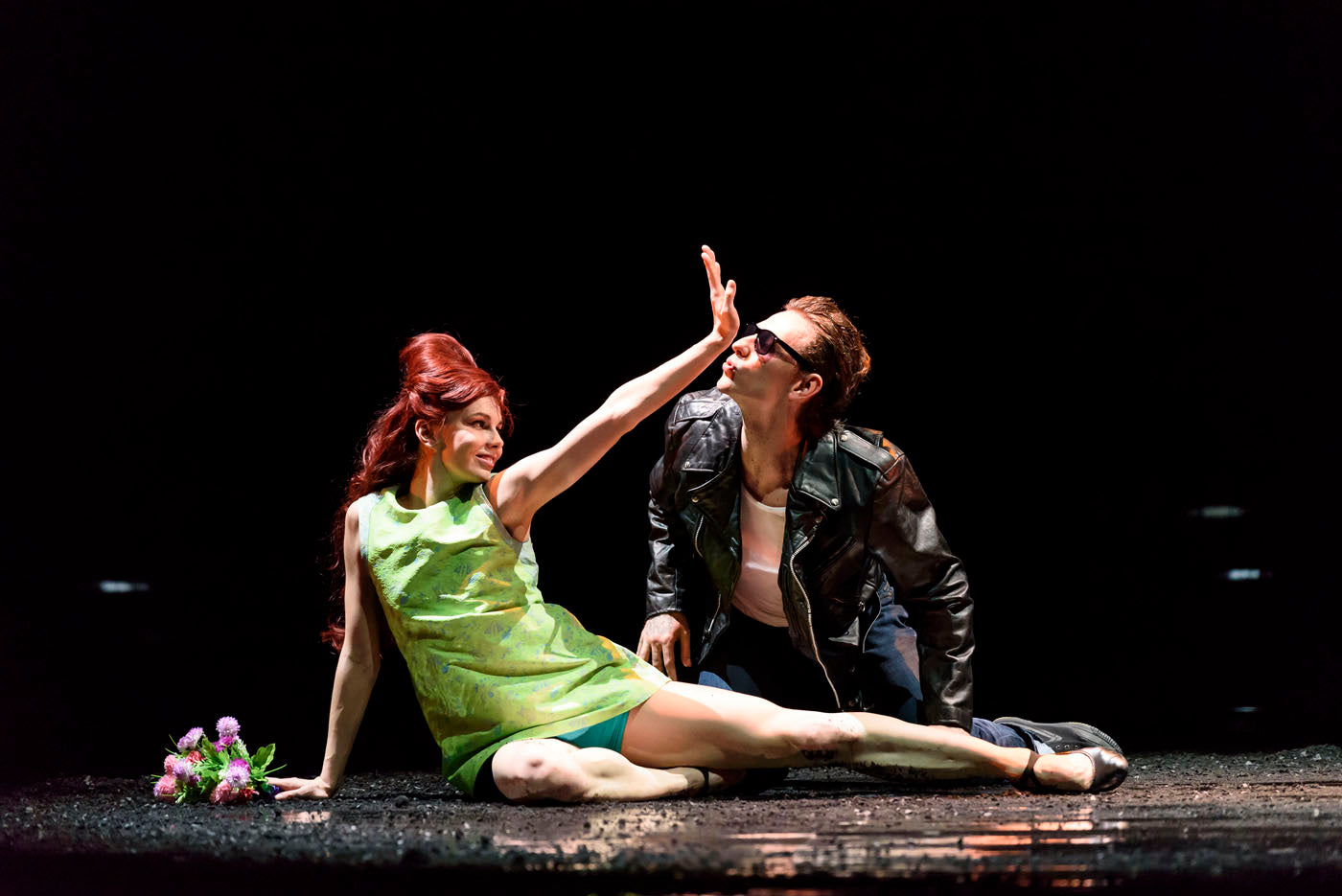
With Pita’s “Run, Mary, Run,” on the other hand, Osipova had no problems getting into the boppy rhythm of the piece, a dark love story in reverse set to the ‘splatter patters’ of 1960s girl group The Shangri-Las. The work is let down by a cheesy, overly literal depiction, though, one that lingers on the narrative and frequently neglects the dance behind it. Osipova and Polunin’s Mary and Jimmy—characters loosely based on Amy Winehouse and Blake S—twist and shout, drink and smoke, fight and make up, theatrics flimsily cobbled together with pantomimic blips of choreography, including a melodramatic lovemaking duet that ends with Jimmy overdosing on heroin.
The lack of subtlety is a shame, though there are some delicate moments that peek through the flash. One in particular stands out: Osipova sitting daintily, her legs stretched to the side and pink skirt spread gracefully around her, looking every inch the jewellery box ballerina. Not a beat later, she shatters this pretty picture, leaping up to run and stamp and fling herself agitatedly. The disruption reads like a metaphor for the programme at large—an attempt to dismantle conceptions of who Osipova is and what she’s capable of. It’s an admirable endeavour, and one that goes far with choreography like Maliphant’s. I’m sad to say that this work, however, falls irredeemably flat.





comments