Based upon the original nineteenth-century novel by Carlo Collodi, the performance follows Pinocchio’s journey to becoming a “real boy.” Much like the chapters of a book, Vardimon flips from adventure to adventure as we encounter the characters Pinocchio must meet and witness the lessons he must learn.
The narrator, embodied by a cluster of white-gloved hands which float together to form an ever-morphing face (much like Lewis Carol’s Cheshire Cat), provides a guiding voice throughout, while also masquerading as Pinocchio’s conscience. In a show aimed at a family audience, the narrator adds an essential clarity to the plotline—although the text does not always flow as smoothly as it could.
In signature style, Vardimon develops the characters of this story through a highly physical movement language. The company appear like living puppets, their clear movement and gesture accompanied by non-verbal sounds that serve to accentuate their emotions.
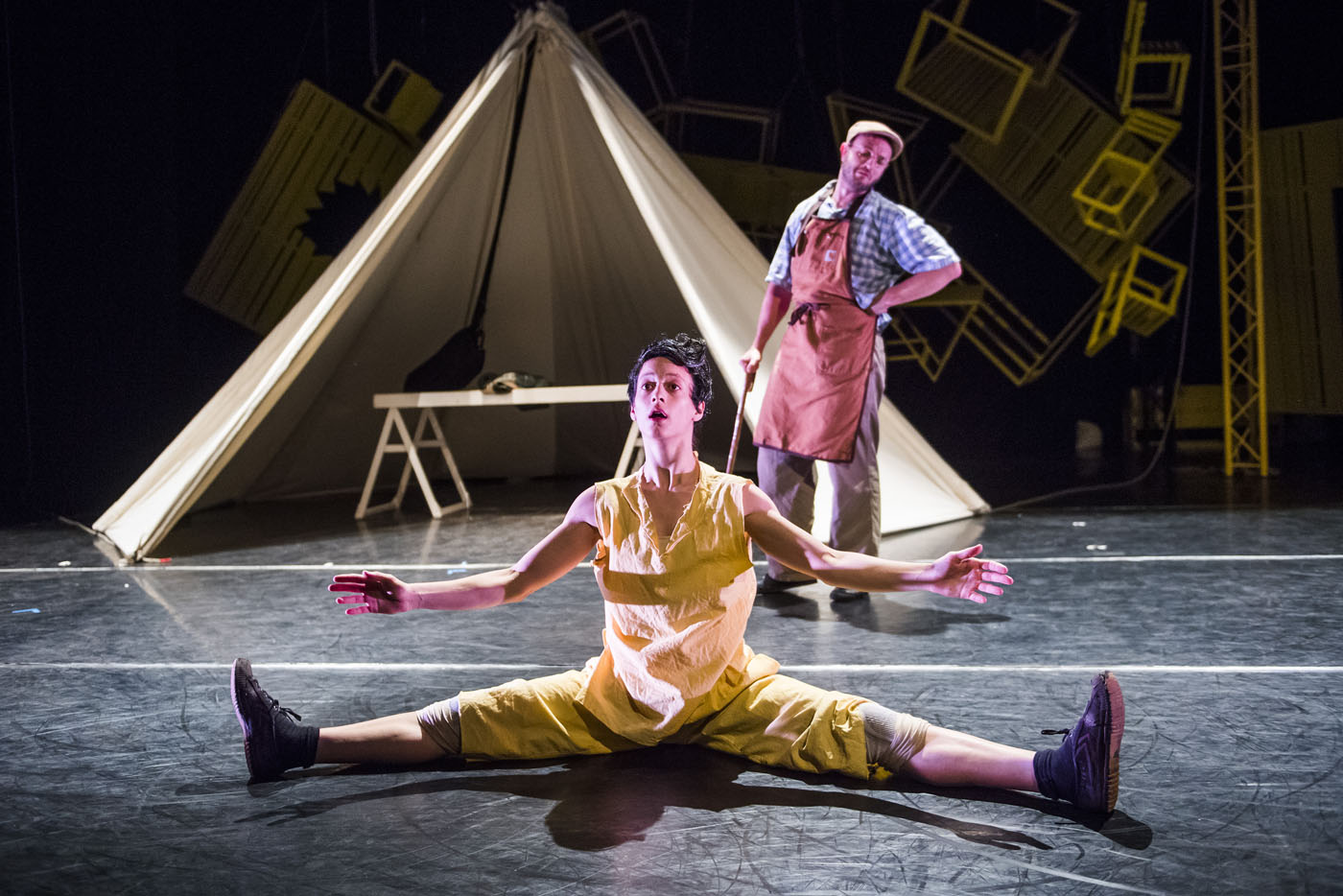
In the role of Pinocchio, dancer Maria Doulgeri demonstrates incredible facility. Staggering into life, her body is at first convincingly rigid, tipped and turned by Geppetto (David Lloyd) like a plank of wood. In his arms her movements slowly loosen, legs skidding at odd angles from her body as, like a new born foal, Pinocchio finds his feet.
Through movement and theatre, Vardimon has created the characters of this story with extraordinary clarity, yet at times their portrayal is over-accentuated. Pinocchio’s extreme naivety, while at first child-like, later becomes an uncomfortable caricature to watch. It’s a precarious line to walk and a number of Vardimon’s larger-than-life characters could benefit from a little more subtlety.
The strength of the production lies in its inventive use of puppetry and set-design. In the marionette theatre the dancers are attached to ropes, tweaked and pulled into action by the counter-weight of their puppeteers. It’s an odd yet enchanting image. Throughout, aerial and harness work add a twist to Vardimon’s choreography and likewise bring Guy Bar-Amotz’s set to life. Pinocchio’s antagonists, the Fox and the Cat, sail away on a floating table, Geppetto is tossed about upon stormy seas—the company’s clever and playful engagement with their physical environment is one of the captivating qualities of this show.
Although this work will undoubtedly attract a family audience, there is no interval and the production could perhaps benefit from one. Some of the dance sequences begin to wear out their welcome. Low to the floor, the dancers slide and spin upon their knees, skimming through dives and rolls. It’s physically demanding choreography, but within it there’s little variation. The music, a compiled soundtrack that changes with each scene, is similarly repetitive, at times looping or recurring with the returning characters.
Despite its catches, Vardimon’s “Pinocchio” remains an enjoyable, imaginative adaptation. The show switches from playful to sinister in a way that perfectly captures the surreal, dream-like feel of the traditional tale—a children’s story with a dark edge and a moral lesson to teach. Vardimon has fully utilised the inventive possibilities of theatre to create an evocative production, filled with striking visual images and a cast of distinctive, engaging characters.





comments