Questo sito non supporta completamente il tuo browser. Ti consigliamo di utilizzare Edge, Chrome, Safari o Firefox.

Cinderella Unites East and West

The National Ballet of Japan’s rendition of the Frederick Ashton classic, “Cinderella,” offers an authentic taste of English tradition, subtly flavored by Japanese aesthetics. A perennial favourite (mounted 13 times by NBJ in the past 20 years), this season’s performances honor both East and West. It’s part of the “Ashton Worldwide 2024–2028” as tribute to the revered choreographer, while also one of 11 works in the Japanese Agency for Cultural Affairs’ 80th annual Arts Festival, featuring both Japanese traditional and Western classical arts.

Performance

The National Ballet of Japan: “Cinderella” by Frederick Ashton

Place

New National Theatre Tokyo, Japan, October 17 2025

Words

Kris Kosaka

Akari Yoshida as the Fairy Godmother in “Cinderella” by Frederick Ashton. Photograph by Kiyonori Hasegawa, courtesy of National Ballet of Japan

The festival was created in the aftermath of World War II to fulfill Japan’s objective to become a country based on the arts—not war. As Ashton’s “Cinderella” was a famously joyful anodyne to the devastating aftermath of war, it seems a fairytale of cross-cultural collaboration for our time.   

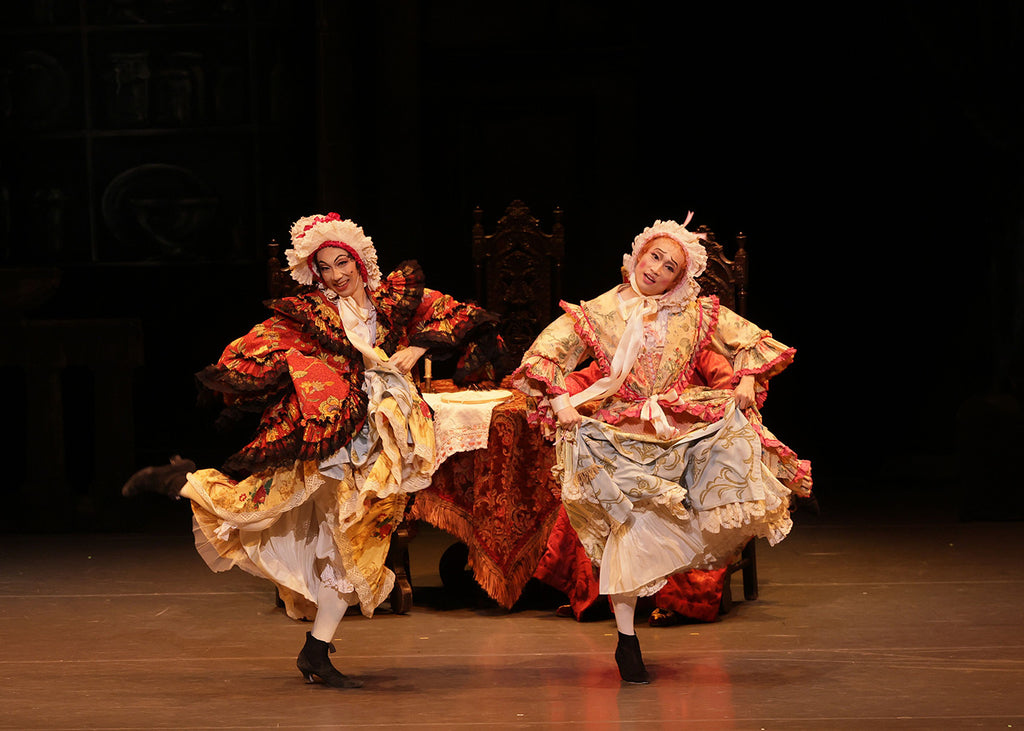
This cross-cultural flair was best demonstrated by Kosuke Okumura and Yu Onodera as the Stepsisters on opening night in Tokyo. Okumura and Onodera imbue the riotous camp roles with androgynous elegance despite their absurd antics. Ashton’s choreography enshrines the silliness, from the stylized Charleston or skidding leaps to their petty skirmishes and visual gags, yet Okumura and Onodera somehow remain gracefully skilled while adhering so completely to character. 

Yui Yonezawa as Cinderella and Takafumi Watanabe as her Prince fulfill their romantic roles with perfection, especially Yonezawa’s sensitive delicacy in her first solo with the broom in Act One, a study in carefully contained dreams under everyday toil and kindness. Later, Yonezawa and Watanabe’s respective solos also impress, as Watanabe showcases his power and exactness alongside his princely appeal. Their pas de deux in Act Two unfolds with quiet ease, the difficult lifts, sustained balances and synchronous partner work muted to a hushed beauty, their love a foregone conclusion. 

Kosuke Okumura and Yu Onodera as the Stepsisters in “Cinderella” by Frederick Ashton. Photograph by Kiyonori Hasegawa, courtesy of National Ballet of Japan

Kosuke Okumura and Yu Onodera as the Stepsisters in “Cinderella” by Frederick Ashton. Photograph by Kiyonori Hasegawa, courtesy of National Ballet of Japan

Despite the freshness and humour of Ashton’s choreography, his storytelling can sometimes feel dated. It’s all about dance, frolic and characterization, after all; there is no conflict or real tension. Cinderella’s famous entrance at the Ball in Act Two is the ballet world’s version of “You had me at hello.” Yet on the night I watched in Tokyo, it’s more than enough. Not only the Prince but the entire ballroom—and Friday night’s adoring Tokyo audience—literally kowtowed at Yonezawa’s mesmerizing entrance, the brilliant effortlessness of her bourrées, her delicately expressive feet, the gorgeous staging. 

Indeed, the staging, comedy, skill and spectacle of Ashton’s classic all make up for the lack of conflict. Later in the act, Watanabe’s besotted determination to find her adds gentle humor instead of strife in the moments after the striking of midnight. No jealous machinations or side-plots—we go straight to the validation of Cinderella’s identity with a clever transition to start Act 3 with a flurry of mini-love tangles from the ball as paired characters speed by in flight.

Yui Yonezawa as Cinderella in “Cinderella” by Frederick Ashton. Photograph by Kiyonori Hasegawa, courtesy of National Ballet of Japan

Yui Yonezawa as Cinderella in “Cinderella” by Frederick Ashton. Photograph by Kiyonori Hasegawa, courtesy of National Ballet of Japan

Yoshito Kinoshita as the Jester is another outstanding technical and comic performance, a welcome dose of virtuoso male dancing after the showcase by women in Act One. Kinoshita remains a scene-stealer throughout, with impeccable timing and skill. From the pinwheel formation of the Stars at the end of Act One to the lively synchronicity of the courtiers at the Ball, the deft ensemble performances also deserve mention. 

Add the numerous distinctly English cultural asides, like the promenade of the oranges, the mockery of the waltz or the easing into a starry tableaux on-stage, and there’s no question that Ashton’s “Cinderella” deserves its place in ballet history. NBJ’s “Cinderella” also feels historically important at this moment in time as an example of how art builds bridges. 


Kris Kosaka


Kris Kosaka is a writer and educator based in Kamakura, Japan. A lifelong ballet fan and studio rat in her youth, she's been contributing to the Japan Times since 2009. She writes across culture, but especially in dance, opera and literature. 

subscribe to the latest in dance


“Uncommonly intelligent, substantial coverage.”

Your weekly source for world-class dance reviews, interviews, articles, and more.

Already a paid subscriber? Login

comments

Ricorda che i commenti devono essere approvati prima di essere pubblicati

Featured

Heartache, on Repeat
SCREEN DANCE | Sarah Elgart

Heartache, on Repeat

With a soundtrack of crashing ocean waves, the opening 30 seconds of the stunning dance short Heartache codirected by Iker Karrera and Alberto D. Centeno delivers a series of singular and seemingly random yet intriguing images that lure the viewer in: A shirtless man, unsteady on his feet, flailing as he attempts to make his way up the staircase of an old building. A pair of legs seated on a bench—their owner hidden by the camera angle. An upstairs POV looking down on a huge, mysteriously beautiful, and darkened room empty of any furnishings, with old and muted walls of peeling...

Continua a leggere
R.A.I.N Dance
REVIEWS | Gracia Haby

R.A.I.N Dance

What form might radical compassion take? If you tease apart an acronym for cultivating mindfulness, and allow a herd of horses to gallop through the middle, what might arise?

Continua a leggere
Good Subscription Agency